

Goods and materials (ТМЦ) are a company's inventories: raw materials, supplies, finished goods and goods for resale. An inventory count compares what is physically in stock with the accounting records. Key Solutions runs the count together with your inventory commission: counting, count sheets, reconciliation statements, the commission protocol and the accounting entries.
+38 (068) 777-14-74 Telegram WhatsApp
In short
- When you need it: before the annual financial statements, when a custodian changes, after theft or damage, before an audit or a sale of the business, or when the tax authority requires a count during a tax audit.
- What you get: count sheets, reconciliation statements and a commission protocol prepared under Ministry of Finance Regulation No. 879 (Положення № 879), a calculation of the tax effect of shortages and the accounting entries.
- Timing: depends on the number of warehouses, the size of the product range and the state of the records. We agree the counting schedule before we start and fix it in the contract.
- Cost: depends on the number of storage locations, the product range, the type of count (full or sample) and where the warehouses are. We quote once you have described the warehouse.
- How to start: book a consultation, name the date or trigger (year-end reporting, a change of custodian, a tax audit) and send the stock movement report.
What goods and materials are, and where they appear in the accounts
In Ukrainian practice ТМЦ covers raw materials, supplies, semi-finished goods, packaging, fuel, finished products and goods for resale. In the balance sheet, inventories sit in Section II «Current assets», line 1100, with lines 1101–1104 for production inventories, work in progress, finished goods and goods for resale. The count is what confirms the figure in line 1100. General rules for all assets are on the inventory of assets in Ukraine page.
Art. 10 of the Law of Ukraine «On Accounting and Financial Reporting in Ukraine» No. 996-XIV (Закон № 996-XIV) requires companies to take inventory of assets and liabilities, checking and documenting their existence, condition and valuation. The detailed rules are set by the Regulation on the Inventory of Assets and Liabilities approved by Ministry of Finance Order No. 879 of 02.09.2014. It applies to Ukrainian legal entities of any form and also to branches and representative offices of foreign legal entities.
Inventory counts run by Key Solutions
Regulation No. 879 allows the inventory commission to include representatives of an audit firm or of the person keeping the books under contract (para. 1, Section II). Our specialists join your commission as audit firm representatives. The commission is chaired by the company head, a deputy, or the head of a structural unit authorised by the company head.
Typical reasons clients order a count of goods and materials:
- the year-end count before the annual financial statements;
- a change of custodian or warehouse manager;
- suspected theft, shortage or mis-sorting;
- preparation for an audit of financial statements under ISA: where inventory is material, the auditor attends the physical count if practicable (ISA 501, para. 4);
- a count required by the tax authority during a tax audit;
- a warehouse check before buying a business or a change of owner;
- long-standing gaps between the accounting system and the warehouse that call for restoration of accounting records.
What the service includes
- a draft order of the company head: items, dates, members of the commission;
- a check of balances in the accounting system on the count date and closing of stock movement documents;
- participation in counting, weighing and measuring by storage location and by custodian;
- count sheets, with separate sheets for damaged stock, goods in transit and stock held at other companies' warehouses;
- a control recount before the warehouse reopens, if the company head decides so;
- reconciliation statements valuing surpluses and shortages at the prices in the accounting records;
- proposals for the protocol: offsetting mis-sorting, write-offs within natural-loss norms, charging shortages to the persons at fault;
- accounting entries under the approved protocol and a VAT calculation on shortages where it applies.
How we work
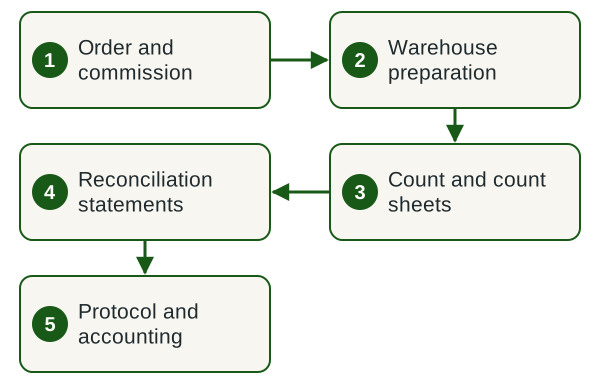
- Order and commission. We agree the items, the date and the commission members and draft the order of the company head.
- Warehouse preparation. Accounting closes stock movement documents, custodians sign their statements, and stock is grouped by name and grade.
- Count and count sheets. The commission counts, weighs and measures the stock in the custodians' presence and fills in the count sheets.
- Reconciliation statements. We compare the physical count with the records and value surpluses and shortages at book prices.
- Protocol and accounting. We draft the protocol with proposals on the differences and record the results once it is approved.
How long an inventory count takes
The duration depends on the number of warehouses and product lines, on the scope (full or sample count) and on the state of the records on the count date. We agree the counting schedule and the deadlines for the reconciliation statements and the draft protocol before we start and fix them in the contract.
Regulatory deadlines run separately. For inventories, the year-end count may take place within three months before the balance sheet date (para. 10, Section I, Regulation No. 879), and the company head approves the commission protocol within 5 working days after the count ends (para. 2, Section IV). Dates for a 31 December balance sheet are best agreed in advance.
When a count is mandatory
Regulation No. 879 lists the mandatory cases in para. 7 of Section I. In these cases the company's own deadlines may not exceed those set by the Regulation.
| Case | Count date | Scope |
|---|---|---|
| Before the annual financial statements | Before the balance sheet date, within the periods of para. 10, Section I | Full count |
| Change of custodian | The day the handover takes place | Assets in that person's custody |
| Theft, abuse or damage established | The day the facts are established | Set by the company head |
| Fire, industrial accident or natural disaster | The day after the event ends | Set by the company head |
| Liquidation of the company | — | Full count |
The tax authority may also require a count of fixed assets, goods and materials and cash during a tax audit (Tax Code of Ukraine (ПКУ), subpara. 20.1.9). If the payer refuses such a count, the tax authority may apply an administrative arrest of property (subpara. 94.2.8).
What affects the cost
| Factor | Effect on scope | What to prepare |
|---|---|---|
| Number of storage locations | Each warehouse or shop needs its own count sheets and commission time | List of warehouses with addresses |
| Size of the product range | More lines mean a longer count and reconciliation | Stock movement report |
| Full or sample count | A full count covers all stock; a sample count covers selected groups or custodians | The company head's decision on scope |
| State of warehouse records | Open movement documents and mis-sorting add work before and after the count | Read-only access to the accounting system |
| Location and schedule | Remote warehouses and work outside warehouse hours are planned separately | Preferred dates and warehouse hours |
What we need from you
- The company head's decision to hold the count (we draft the order).
- A stock movement report and a list of storage locations.
- Read-only access to the accounting system (BAS or another).
- The custodians present at each warehouse.
- A management representative on the commission and an employee who knows the product range and prices.
- Working scales and measuring tools, and approved natural-loss norms if you have them.
What you receive
- count sheets signed by the commission, with the custodians' statements;
- reconciliation statements with the value of surpluses and shortages;
- the inventory commission protocol with proposals on the differences;
- a calculation of the tax effect of shortages;
- entries in the accounts for the period in which the count ended;
- a list of corrections to warehouse records for the next period.
Find out the cost of a count
Describe the warehouse and the trigger: year-end reporting, a change of custodian or a tax audit. We will reply with the scope, timing and cost.
Shortages, mis-sorting and VAT
Section IV of Regulation No. 879 sets a strict order: mis-sorting (пересортиця) is offset first, then losses within approved natural-loss norms are written off, and only after that is an excess shortage recognised.
- Mis-sorting may be offset only for items with the same name, in identical quantities, arising in the same period and with the same custodian.
- Shortages within natural-loss norms are written off to expenses by order of the company head, after the mis-sorting offset.
- Shortages above the norms and losses from damage are charged to the persons at fault; if none are identified, they go to an off-balance-sheet account. Without approved norms, any loss counts as a shortage above the norm.
The main tax risk is VAT. If a shortage of purchased goods is recorded in a sample count carried out at the tax authority's request, the goods are treated as used outside business activity (Tax Code, para. 198.5), and the tax base is their purchase cost (para. 189.1). Shortages caused by force majeure confirmed under the law are excluded.
Late or poor-quality counts of cash and tangible assets are an administrative offence under Art. 164-2 of the Code of Ukraine on Administrative Offences (КУпАП): a fine of 8 to 15 tax-free minimum incomes of citizens (НМДГ), or 10 to 20 for a repeat offence within a year. For fines, one НМДГ equals UAH 17, so the base fine is UAH 136–255.
Legal basis
Rules the work relies on
- Art. 10 of Law No. 996-XIV — the duty to take inventory; the company head sets items and frequency outside the mandatory cases.
- Regulation No. 879, paras 7 and 10 of Section I — mandatory cases and year-end count periods.
- Regulation No. 879, para. 1 of Section II — members of the inventory commission, including audit firm representatives.
- Regulation No. 879, Section IV — protocol, offsetting mis-sorting, writing off shortages.
- Tax Code of Ukraine, subparas 20.1.9 and 94.2.8 — counts required by the tax authority and the consequences of refusal.
- Tax Code of Ukraine, para. 198.5 — VAT on shortages found in a count requested by the tax authority.
- Art. 164-2 of the Code on Administrative Offences — liability for late or poor-quality counts.
Risks, and why to hand the count to a team under contract
Counting errors carry a price. A shortage of goods in a count held at the tax authority's request creates output VAT under para. 198.5 of the Tax Code. Count sheets with corrections or without the custodians' statements breach Regulation No. 879 and make it harder to recover the loss from the persons at fault. A loss with no approved natural-loss norm is treated as a shortage above the norm.
We work under a contract that fixes scope, schedule and liability before the start, and we prepare the documents under Regulation No. 879. Our specialist on the commission is independent of the warehouse and its custodians. Court claims against the persons at fault are handled by the group's lawyers at legal.ua.
Why Key Solutions
- Company
- ТОВ «АУДИТОРСЬКА ФІРМА «КЕЙ СОЛЮШНЗ», a Ukrainian limited liability company, EDRPOU code 39610085. Company details are public in the Unified State Register (ЄДР).
- Contract
- We work under a contract: scope, timing and liability are fixed before the work starts. Client information is protected by professional secrecy (Art. 11 of Law No. 2258-VIII).
- Group
- We are part of Innova Consulting Group: legal matters are handled by legal.ua, crypto-asset taxation by crystal.tax.
- Office
- Our office is at 77 Velyka Vasylkivska St., Kyiv. We serve clients across Ukraine remotely. The specialists who run projects are listed on the Our employees page.
Frequently asked questions
What are goods and materials (ТМЦ) in accounting?
ТМЦ are a company's inventories in physical form: raw materials, supplies, semi-finished goods, fuel, packaging, finished products and goods for resale. In the financial statements they appear in Section II of the balance sheet, line 1100, with lines 1101–1104 among the additional items.
How often must a company count its goods and materials?
At least once a year, before preparing the annual financial statements, within the period before the balance sheet date set by para. 10, Section I of Regulation No. 879. A count is also mandatory when a custodian changes, when theft, abuse or damage is established, after a fire and when the company is liquidated (para. 7, Section I).
Who sits on the inventory commission?
Representatives of management, of the accounting function (including representatives of an audit firm or of a person keeping the books under contract) and experienced employees who know the items, the prices and the primary records. Custodians are kept off the working commission that checks the assets in their own custody.
Can an audit firm take part in an inventory count?
Yes, as a member of the commission: para. 1, Section II of Regulation No. 879 allows representatives of an audit firm to be included. The commission is set up by an order of the company head and chaired by the head, a deputy, or an authorised head of a structural unit. Key Solutions drafts the order, takes part in the count and prepares the reconciliation statements and the draft protocol.
What happens if a shortage is found during the count?
The commission first checks whether the shortage can be offset against mis-sorting. Losses within approved natural-loss norms are then written off to expenses by order of the company head, and shortages above the norms are charged to the persons at fault as provided by law. If no one at fault is identified, the amount goes to an off-balance-sheet account.
Can mis-sorting be offset against a shortage?
Only for items with the same name and in identical quantities, where the surplus and the shortage arose in the same period under review and with the same custodian. If the missing items cost more than the surplus items, the difference is charged to the persons at fault.
Is VAT charged on a shortage of goods?
Yes, when a shortage of purchased goods is recorded in a sample count carried out at the request of the tax authority: such goods are treated as used outside business activity (Tax Code, para. 198.5). The tax base is the purchase cost of the goods under para. 189.1.
How much does an inventory count cost?
The cost depends on the number of warehouses, the size of the product range, the type of count (full or sample), the state of warehouse records and where the warehouses are. We name the exact amount after you describe the warehouse and fix it in the contract or invoice before the work starts.
Related services
Discuss your warehouse count
In your request, give the number of warehouses and custodians, the approximate number of product lines and the date the count is needed for. We will reply with the scope of work, the counting schedule and the cost.
Book a consultation Order the service +38 (068) 777-14-74 Telegram WhatsApp