


Financial and tax due diligence is a review of a Ukrainian company before an acquisition, investment or loan that shows its real earnings, debt and tax exposure. Key Solutions reports each risk with an amount, the rule behind it and a recommendation for the deal.
+38 (068) 777-14-74 Telegram WhatsApp
In short
- When you need it: before buying a stake or a business, bringing in an investor, lending against the company's cash flow, or before selling a business (vendor due diligence).
- What you get: a report with normalised earnings, net debt and tax risks in hryvnias, each with the rule of the Tax Code of Ukraine (ПКУ) and a recommendation for the purchase agreement.
- Timing is fixed in the contract after we review the deal perimeter. Getting documents from the seller usually takes the longest.
- Cost depends on the number of legal entities, how many tax periods are still open, the state of source documents and the report language.
- Where to start: describe the deal at a consultation; then we sign an NDA and the engagement contract.
When due diligence is carried out
Due diligence is a review of the target on behalf of a buyer, investor or lender before the deal is signed. The financial part shows how much the company earns and owes, and the tax part shows what the tax authority could assess for periods that are still open.
- Buying a stake or shares. The tax history stays with the legal entity and passes to the new owner with the stake.
- A new investor or partner. The investor tests the figures behind the valuation.
- A loan or lease. The lender assesses the debt and the cash flow that will repay it.
- Selling a business (vendor due diligence). The seller finds weak spots first; under martial law, errors self-corrected under Article 50 of the Tax Code carry no para. 50.1 penalty and no late-payment interest (subpara. 69.38, subsection 10, section XX).
- Reorganisation and mergers. The successor takes on the predecessor's tax liabilities.
Legal due diligence (corporate decisions, title to assets, disputes) is done by the group's lawyers at legal.ua. Key Solutions covers the financial and tax parts, and the findings of both teams go into one document for the deal.
How due diligence differs from an audit of financial statements
An audit of financial statements answers whether the statements are reliable. Due diligence answers what exactly the buyer gets with the company and what it is worth.
Under the Law on Audit of Financial Statements and Auditing Activity (Law No. 2258-VIII), due diligence is one of the other professional services (item 7, part 1, Art. 1), and its scope is set by the contract (part 2, Art. 7). Some assignments are agreed-upon procedures under ISRS 4400 (Revised): the report of factual findings carries no opinion or assurance, and deal recommendations come in a separate section.
| Criterion | Audit of financial statements | Due diligence |
|---|---|---|
| Client | The company whose statements are audited | Buyer, investor or lender; sometimes the seller (vendor DD) |
| Purpose | Independent opinion on the statements in all material respects | Risks, quality of earnings and real value |
| Scope | Set by law and auditing standards | Set by the contract: entities, periods, accounting areas |
| Result | Auditor's report with an opinion in the prescribed form | Risks in money and recommendations for the deal |
What due diligence includes
- Quality of earnings: one-off income, related-party transactions, revaluations; normalised earnings for the price formula.
- Net debt: loans, leases, factoring, deferred payments, sureties given for third parties.
- Working capital and receivables: seasonality, ageing, concentration on a few customers.
- Assets: whether what physically exists matches the books; attendance at counts of fixed assets and inventories.
- Taxes for open periods: corporate income tax, VAT and registration of tax invoices in the Unified Register of Tax Invoices (ЄРПН), personal income tax and the unified social contribution (ЄСВ), transactions with non-residents.
- Transfer pricing, controlled foreign company rules and Diia.City resident status, where they apply.
- A calculation for each risk: additional tax, penalty and late-payment interest with the Tax Code rule.
- Recommendations for the agreement: price adjustment, holdback, seller warranties and indemnities.
How we work
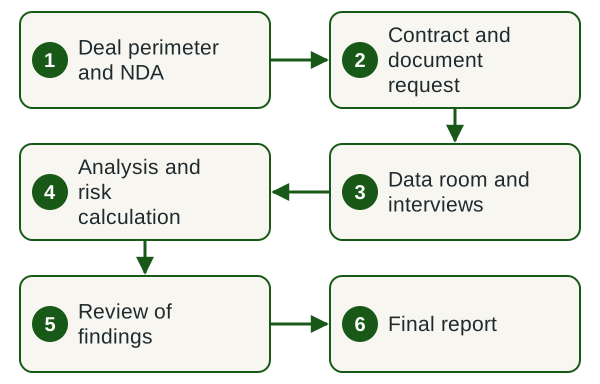
- Deal perimeter and NDA We agree the entities, periods, accounting areas and the deal deadline.
- Contract and document request We fix scope, timing and fee and send the data room checklist.
- Data room and interviews We work with documents and the accounting system and talk to the CFO and chief accountant.
- Analysis and risk calculation We normalise earnings and debt and calculate tax, penalties and interest for each issue.
- Review of findings We present preliminary findings to you and your lawyers and clarify disputed issues with the seller.
- Final report We deliver the report and recommendations for the purchase agreement.
Timing
We fix the timing in the contract after reviewing the perimeter. In our experience, getting documents and system access from the seller takes the longest, so timing depends on how ready the data room is, the number of entities and the state of source documents. A group with controlled transactions takes longer because the review period is longer (para. 102.1 of the Tax Code).
How much due diligence costs
We price each deal after reviewing the perimeter and fix the fee in the contract. Five factors drive it.
| Factor | Effect on scope | What to prepare |
|---|---|---|
| Entities in the perimeter | Each group company has its own books and tax periods | Group structure and shareholdings |
| Depth of open periods | Transfer pricing, CFC rules and unfiled returns widen the sample | List of filed returns and tax audit reports |
| State of source documents | Gaps in source documents lengthen fieldwork | Access to the accounting system |
| Scope of review | Financial, tax or both; legal review by legal.ua | Priority risks for the buyer |
| Report language and deadline | An English version and a tight deadline add work | Deal signing date |
What we need from you
- An NDA and the seller's consent to data access.
- Financial statements, trial balances and ledgers for the review periods.
- Tax returns, filing receipts, and reports and decisions from earlier tax audits.
- Credit and lease agreements and contracts with key counterparties.
- Read-only access to the accounting system (BAS or another).
- A contact on the seller's side: the CFO or chief accountant.
- The deal deadline and the risks that concern you most.
What you receive
Each finding reads as risk, amount, rule, action. Estimates of fair value, impairment and provisions are reviewed with professional scepticism (part 2 of Art. 9 of Law No. 2258-VIII).
- An executive summary for the deal decision: key risks and their amounts.
- Normalised earnings and net debt for the price formula.
- A register of tax risks by period with the Tax Code rule, penalty and interest.
- Red flags and questions for the seller.
- Recommendations for the agreement: price, holdback, warranties, indemnities, conditions precedent.
Get a quote for due diligence
Describe the deal: which company you are reviewing, how many entities are in scope and when signing is planned. We will reply with the scope of procedures, timing and price.
How far back the tax review goes
The limitation period sets how far back the tax authority can assess, and so how deep the sample goes.
| What sets the depth | Period | Rule |
|---|---|---|
| Assessment after a tax audit | 1,095 days; suspended for COVID-19 quarantine and for audits not carried out under martial law | Tax Code, para. 102.1; para. 52-2, subpara. 69.36, subsec. 10, sec. XX |
| Transfer pricing, CFC and para. 141.4 audits | 2,555 days | Tax Code, para. 102.1 |
| Collection of debt after assessment | 1,095 days | Tax Code, para. 102.4 |
The period runs from the filing deadline, or from the actual filing date if the return was late (para. 102.1). The COVID-19 suspension ran from 18 March 2020 (para. 52-2, whose own effect is suspended for the period of martial law). Periods with no return filed have no limitation period (para. 102.2 of the Tax Code). We calculate the cut-off date for each period separately: a period older than three years may still be open.
Red flags that stop a deal
- Source documents are missing or are being restored on request.
- Periods with no tax return filed, which have no limitation period.
- A large share of revenue runs through related parties or high-risk counterparties.
- Published annual statements differ from the seller's management figures.
- An unfinished appeal against a tax assessment, which suspends the limitation period.
- Staff engaged as sole proprietors (ФОП) while the relationship has the features of employment.
- A reorganisation (other than a change of legal form) or liquidation already under way, which is a ground for an unscheduled tax audit (subpara. 78.1.7 of the Tax Code).
How findings shape the price and the purchase agreement
Findings are used in three ways: a lower price, shifting the risk to the seller in the agreement, or walking away. Each relies on a quantified risk.
- Price adjustment. Recalculated normalised earnings and actual net debt replace the seller's figures in the price formula.
- Holdback or escrow. Part of the price is held until the period in which the risk may crystallise expires, guided by the periods in paras 102.1 and 102.4 of the Tax Code.
- Seller warranties. Targeted: taxes paid in full for specific periods, no undeclared liabilities, source documents in place.
- Indemnity. A separate obligation of the seller to cover an assessment on a specific issue, including penalty and interest.
- Conditions precedent. The breach is fixed before closing.
After closing, an assessment is payable within 10 working days of receipt unless appealed within the same period (paras 56.3 and 57.3 of the Tax Code), so the agreement should say in advance how the parties respond.
Legal framework
Rules the work relies on
- paras 102.1–102.4 of the Tax Code — limitation periods that set the depth of the tax review.
- para. 52-2, subparas. 69.36–69.38, subsection 10, section XX of the Tax Code — suspension of limitation periods and release from penalties and interest under martial law.
- Arts 44, 44-1 of the Tax Code — source documents, retention periods, beneficial ownership information.
- Arts 120-1, 121, 123, 129 of the Tax Code — penalties and interest used to measure risk.
- Arts 1, 7, 9 of Law No. 2258-VIII — audit services, the contract, professional scepticism.
- Art. 14 of Law No. 996-XIV — access to and publication of financial statements.
Risks and why to hand this to a team under contract
Without due diligence, a buyer takes on assessments for open periods, penalties, interest and debts missing from the seller's presentation. A wrong review depth is costly: a period that looked closed may still be open because limitation periods were suspended. Our auditor, tax adviser and the legal.ua lawyer work from one data room under a contract that fixes scope, timing and liability. A chatbot overview helps with a first look; a pricing decision needs a report with rules and amounts.
Why Key Solutions
- Company
- LLC Audit Firm Key Solutions (ТОВ «АУДИТОРСЬКА ФІРМА «КЕЙ СОЛЮШНЗ»), EDRPOU code 39610085. The company's details are public in the Unified State Register (ЄДР).
- Contract
- We work under a contract: scope, timing and liability are agreed before work starts. Client information is protected by professional confidentiality (Art. 11 of Law No. 2258-VIII).
- Group
- We are part of Innova Consulting Group: legal matters are handled by legal.ua, crypto-asset taxation by crystal.tax.
- Office
- Our office is at 77 Velyka Vasylkivska St, Kyiv. We serve clients across Ukraine remotely. The specialists who run projects are listed on the Our employees page.
Frequently asked questions
What is tax due diligence?
Tax due diligence is a review of the taxes a target company paid and filed for periods that are still open. Each issue the tax authority could assess becomes an amount in hryvnias, with penalty, late-payment interest, the Tax Code rule and a recommendation for the purchase agreement.
How much does due diligence cost?
We price each deal after reviewing its perimeter. The fee depends on the number of legal entities, open tax periods, controlled transactions, the state of source documents, the report language and the deadline. Fee and timing are fixed in the contract before the data room opens.
How does financial due diligence differ from a financial statement audit?
An audit ends with the auditor's independent opinion on whether the statements comply with accounting standards in all material respects. Due diligence assesses risks and the real value of the target for the buyer, and its report carries no opinion on the statements. Its scope is set by the contract (part 2 of Art. 7 of Law No. 2258-VIII).
How many years does tax due diligence cover?
The depth follows the limitation period under para. 102.1 of the Tax Code: 1,095 days for ordinary audits and 2,555 days for transfer pricing, CFC and para. 141.4 audits, with suspensions for appeals and for audits not carried out under martial law. Periods with no return filed have no limitation period (para. 102.2).
How do you check a Ukrainian company before buying it?
We start with public data: large and medium-sized companies publish annual statements with an auditor's report (Art. 14 of Law No. 996-XIV). We then compare these figures with the seller's management data, check source documents and tax filings for open periods in the data room and calculate the risks in hryvnias.
Do a company's tax debts pass to the buyer?
When you buy corporate rights, the tax history stays inside the legal entity, so the tax risk for open periods passes to the new owner with the stake. In a reorganisation, the Tax Code places tax liabilities on the successors, in a division in proportion to the book value of the assets each receives (para. 98.2).
Can the due diligence report be in English?
Yes. We prepare the report in English for foreign buyers, investors and lenders. The report language and the deadline are agreed in the contract, and we allow for the English version when setting the timing and fee.
Related services
Discuss your deal
Send the name or EDRPOU code of the company you are reviewing, your role (buyer, investor or seller) and the deal date. We will reply with the review perimeter, the data room checklist, timing and price.
Book a consultation Order the service +38 (068) 777-14-74 Telegram WhatsApp