


Accounting for importers is bookkeeping and tax accounting for a company that brings goods into Ukraine: customs declarations, import VAT, batch cost, exchange differences and currency settlement deadlines. Key Solutions keeps importers’ books under contract, in Kyiv and remotely.
+38 (068) 777-14-74 Telegram WhatsApp
In short
- When you need it: the company has started importing or exporting, pays advances to a non-resident supplier, works with VAT and a warehouse.
- What you get: every shipment recorded, input VAT claimed on customs declarations, currency settlement deadlines tracked and reports filed.
- Timing: with a full set of documents we take over from the next reporting month; if there are gaps, we restore the books first.
- Cost: depends on the number of shipments and customs declarations, currencies, VAT status and the warehouse. We quote after a review.
- First step: book a consultation and tell us the supplier countries, payment terms and the approximate number of shipments per month.
How importing changes a company’s accounting
Import accounting has three distinct features: VAT (ПДВ) is paid at customs, the value of goods is set in foreign currency at the National Bank of Ukraine (НБУ) rate, and the bank checks payments to non-residents against settlement deadlines. The rules come from the Tax Code of Ukraine (ПКУ), Ukrainian national accounting standards (НП(С)БО, NP(S)BO below) and NBU currency regulations.
| Transaction | What we record | Legal basis |
|---|---|---|
| Goods imported | VAT liability on the date the customs declaration is filed; payment before or on filing | Tax Code, paras. 187.8, 206.1 |
| Input VAT | Date of VAT payment at customs; the customs declaration is the supporting document | Tax Code, paras. 198.2, 201.12 |
| Goods received | Supplier price at the NBU rate, import duty, freight and insurance | NP(S)BO 9, para. 9; NP(S)BO 21, para. 5 |
| Prepayment to a non-resident | Goods at the advance-date rate; delivery within the deadline, generally 180 days | NP(S)BO 21, para. 6; NBU Resolution No. 18, para. 14-2 |
| Payable to the supplier | Remeasured at the balance sheet date rate, exchange differences | NP(S)BO 21, paras. 7(a), 8 |
The VAT base on import is the contract value or the customs value, whichever is higher, including duty and excise (Tax Code, para. 190.1). The rate is 20%, or a reduced rate for certain Ukrainian customs tariff codes (УКТ ЗЕД) (para. 193.1).
Transactions with a related non-resident become controlled when the company’s annual income exceeds UAH 150 million and the volume with that counterparty exceeds UAH 10 million (Tax Code, subpara. 39.2.1.7). The report on them is due by 1 October of the following year (para. 39.4.2); we prepare the documentation within our transfer pricing service.
Accounting for fruit and food importers
Fruit and food imports add short shelf lives, storage losses and batch tracking to the books. For these companies we keep:
- batch records with the customs declaration date, exchange rate and customs payments;
- spoilage, markdown and write-off reports signed by a stock committee;
- regular stock counts at the warehouse;
- a check of the VAT rate against the tariff code in each customs declaration.
Export accounting
Exports of goods are taxed at a zero VAT rate (Tax Code, subpara. 195.1.1). The VAT liability arises on the earlier of payment or shipment, and for exports the shipment date is the date the customs declaration is processed (para. 187.1). Export proceeds must reach an account at a Ukrainian bank within the settlement deadline, counted from customs clearance, under the Law on Currency and Currency Transactions No. 2473-VIII (Закон «Про валюту і валютні операції»), Art. 13(2). If an exporter builds up a negative VAT balance, we prepare the VAT refund package.
What the service includes
- accounting for foreign trade contracts, invoices, specifications and transport documents;
- customs declarations, import duty, excise and import VAT;
- batch cost and warehouse accounting;
- exchange differences, currency accounts, purchase and sale of foreign currency;
- a register of settlement deadlines for each contract;
- tax invoices on sales of imported goods and their registration in the Unified Register of Tax Invoices (ЄРПН);
- VAT and corporate income tax returns, financial statements, replies to bank and tax authority requests.
How we work
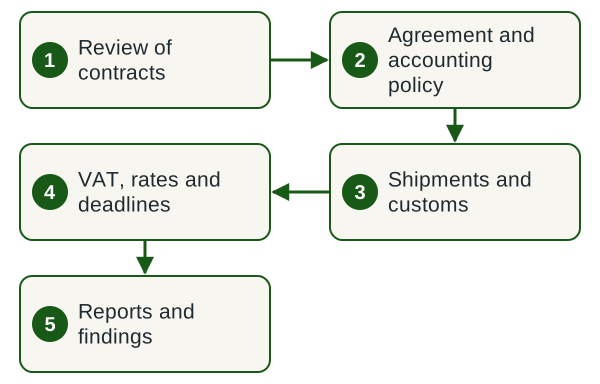
- Review of contracts. We read the contracts, delivery and payment terms, and check the current books.
- Agreement and accounting policy. We agree the scope, document deadlines and the inventory valuation method.
- Shipments and customs. We record batches from customs declarations, with duty and VAT.
- VAT, rates and deadlines. We build input VAT and exchange differences, and track settlement deadlines per contract.
- Reports and findings. We file returns and financial statements and set out what to change in the books.
Timing
In our experience, with a full set of documents we take over an importer’s books from the next reporting month. If warehouse, customs and bank data for past periods do not match, we restore the books first. We file the VAT return within 20 calendar days after the end of the month (Tax Code, subpara. 49.18.1).
What affects the cost
- number of shipments and customs declarations per month;
- number of currencies, banks and contracts with non-residents;
- VAT status, and whether you import and export at the same time;
- the warehouse: product range, batches, shelf lives;
- the state of the books at the start;
- controlled transactions and IFRS reporting.
We quote the monthly fee after a review and fix it in the contract before work starts.
What we need from you
- Foreign trade contracts, specifications and invoices.
- Customs declarations and carrier documents for each shipment.
- Bank statements for foreign currency and hryvnia accounts.
- Access to the accounting database or a copy of it, and warehouse reports.
- A contact person who approves documents and answers bank requests.
What you receive
- every shipment recorded from prepayment to sale, with exchange rates and customs payments;
- input VAT from customs declarations in the period the tax was paid;
- a register of settlement deadlines with reminders before they expire;
- filed tax returns and financial statements;
- a letter listing risks and proposed changes to the accounting policy.
Find out the cost of import accounting
Tell us the number of shipments per month, your currencies and whether you are VAT-registered. We will reply with the scope of work and the monthly fee.
Legal basis
Rules this work relies on
- Tax Code, paras. 187.8, 190.1, 198.2, 201.12 — import VAT: liability date, base, date and supporting document for input VAT.
- Tax Code, subpara. 195.1.1, para. 187.1 — zero rate and liability date on export.
- Tax Code, subpara. 39.2.1.7, para. 39.4.2 — controlled transactions and the report on them.
- Law No. 2473-VIII, Art. 13 — settlement deadlines, penalty, extension of deadlines.
- NBU Board Resolution No. 18, paras. 14-2, 14-3 (постанова Правління НБУ № 18) — general settlement deadline and exceptions to it.
- NP(S)BO 9 “Inventories”, para. 9 (НП(С)БО 9 «Запаси») — what makes up the initial cost of inventories.
- NP(S)BO 21 “Effects of Changes in Foreign Exchange Rates”, paras. 5–8 (НП(С)БО 21 «Вплив змін валютних курсів») — rate on the transaction, advance and balance sheet dates, exchange differences.
Risks and why to hand accounting to a contracted team
For a missed settlement deadline on an import, the tax authority charges a penalty for each day of delay (Art. 13(5) of Law No. 2473-VIII). The deadline can be extended by a conclusion of the central executive body for economic development (Art. 13(4)), so we flag contracts at risk of delay in advance. An error in the date or amount of a customs declaration moves input VAT into another period, and a wrong exchange rate distorts cost of sales and profit.
The firm is liable to the client under the contract as a legal entity. Contracts with non-residents and disputes with suppliers are handled together with legal.ua.
Why Key Solutions
- Company
- ТОВ «АУДИТОРСЬКА ФІРМА «КЕЙ СОЛЮШНЗ», a Ukrainian limited liability company, EDRPOU code 39610085. The company's details are public in the Unified State Register (ЄДР).
- Register
- Key Solutions is entered in the Register of Auditors and Audit Entities (Реєстр аудиторів та суб'єктів аудиторської діяльності) under No. 4669.
- Contract
- We work under a written contract: scope, deadlines and liability are agreed before work starts. Client information is protected by professional confidentiality (Art. 11 of the Law on Audit of Financial Statements and Auditing Activities No. 2258-VIII, Закон «Про аудит фінансової звітності та аудиторську діяльність»).
- Group
- We are part of Innova Consulting Group: legal matters are handled by legal.ua, crypto-asset taxation by crystal.tax.
- Office
- Our office is at 77 Velyka Vasylkivska St, Kyiv. We serve clients across Ukraine remotely. The specialists who run projects are listed on the Our employees page.
Frequently asked questions
When does input VAT on imported goods arise?
Input VAT on imports arises on the date VAT is paid under the customs declaration (Tax Code, para. 198.2, fourth paragraph). The supporting document is the customs declaration itself, which confirms the VAT payment (para. 201.12); a tax invoice is not required for this.
Which exchange rate is used to record imported goods?
Imported goods are recorded at the NBU rate at the start of the transaction date (NP(S)BO 21, para. 5). If the supplier was paid in advance, the goods are valued at the rate on the advance date; with several advances, at the rate of each advance in turn (para. 6).
What goes into the cost of imported goods?
The cost of imported goods is the supplier price net of indirect taxes, plus import duty, indirect taxes the company cannot recover, and transport and procurement costs, including freight and insurance (NP(S)BO 9, para. 9).
Does a company that is not VAT-registered pay import VAT?
Yes. Import VAT is paid at customs by any person importing goods in taxable volumes (Tax Code, subpara. 3 of para. 180.1). A company without VAT registration cannot recover this tax, so it becomes part of the cost of goods (NP(S)BO 9, para. 9).
What is the settlement deadline for imports in 2026?
The general settlement deadline for imports of goods is 180 calendar days (NBU Board Resolution No. 18 of 24 February 2022, para. 14-2). The NBU sets exceptions and special rules for certain goods and sectors (subpara. 2 of para. 14-3), so we check the deadline for each contract. With prepayment, the deadline runs from the advance payment date (Art. 13(3) of Law No. 2473-VIII). Low-value transactions fall outside these deadlines (subpara. 1 of para. 14-3).
What happens if the supplier fails to deliver after prepayment?
If the goods do not arrive within the deadline, the tax authority charges, following an inspection, a penalty of 0.3% of the value of undelivered goods for each day of delay, capped at that value (Art. 13(5) and 13(8) of Law No. 2473-VIII). The deadline is suspended by force majeure confirmed by a certificate, or by a claim against the non-resident accepted by a court or arbitration (Art. 13(6) and 13(7)).
Who handles customs clearance if you keep our books?
Customs clearance and filing of customs declarations stay with your customs broker or your company’s declarant. Key Solutions accounts for the result: we check declaration details, record duty, excise and VAT, and build input VAT and batch cost. Contract issues and supplier disputes are handled together with legal.ua.
Related services
Let’s discuss your import accounting
Tell us which countries you buy from and in which currency, whether you prepay, whether you have VAT and a warehouse, and how many shipments arrive per month. We will reply with the scope of work, the monthly fee and a start date.
Book a consultation Order the service +38 (068) 777-14-74 Telegram WhatsApp