

Financial risk management is the system a company uses to identify, measure and control the risks of losing money: liquidity, credit, currency, interest rate and tax risks. Key Solutions diagnoses risks from your own accounting data, builds a risk register, limits and a cash calendar, and sets up monthly monitoring.
+38 (068) 777-14-74 Telegram WhatsApp
In short
- When you need it: cash gaps, growing overdue receivables, foreign currency contracts, loans with covenants, a request from a bank or investor, falling net assets.
- What you get: a risk map and register, limits, stress scenarios, a cash calendar and monthly monitoring procedures.
- Timing: in our experience, a diagnostic takes a few weeks after we receive the data. The timetable goes into the contract.
- Fee: agreed individually, based on the number of entities, the state of the accounts and the format.
- How to start: send last year's financial statements and trial balance.
Types of financial risk
Each type of financial risk has its own signal in the accounts and its own control.
| Risk | How it shows | How we control it |
|---|---|---|
| Liquidity | Profit on paper, but not enough cash to pay on time | Cash calendar, minimum balance, reserve |
| Credit | Customers pay late or not at all | Customer limits, receivables ageing, payment terms |
| Currency | Exchange rates change import costs or hryvnia revenue | Currency position, currency clauses in contracts |
| Interest rate | Loan or lease rates rise | Debt schedule, rate sensitivity, covenants |
| Tax | Additional assessments, suspended VAT invoices, risky taxpayer status | Tax calendar, counterparty checks, primary documents |
Early warning signs
- Net assets of an LLC fall by more than 50 % against the previous year end: a general meeting must be held within 60 days (Art. 31 of Law No. 2275-VIII).
- A threat of insolvency, defined as being unable to meet monetary obligations on time over the next 12 months (Art. 1 of the Bankruptcy Code).
- VAT invoices suspended under the risk criteria of Cabinet of Ministers Resolution No. 1165.
- Receivables older than 90 days growing month after month.
What the service includes
- a diagnostic of financial statements, trial balances and payments;
- a risk map and register with probability, impact, owners and actions;
- a 13-week cash calendar and minimum balance rules;
- customer limits, payment terms and an overdue receivables procedure;
- currency and interest rate exposure analysis with stress scenarios;
- a tax risk review and a monthly management report template.
How we work
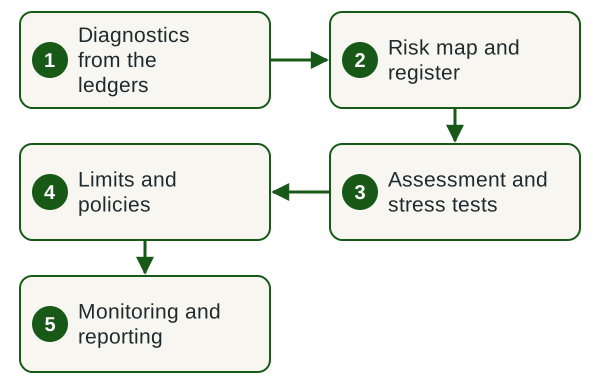
- Diagnostics from the ledgers. We analyse statements, payments, receivables, loans and currency contracts.
- Risk map and register. We record risks, owners, probability and cash impact.
- Assessment and stress tests. We test liquidity against changes in rates, currency and customer payments.
- Limits and policies. We set limits, payment rules, currency position rules and a minimum balance.
- Monitoring and reporting. We set up a monthly report and a procedure for responding to deviations.
What we need from you
- Financial statements and a trial balance for the last year.
- Bank statements or a payment register for three to six months, and a list of loans and leases.
- Receivables and payables broken down by age.
- Key contracts with currency and price terms.
- A person who will keep the risk register after launch.
What you receive
- a risk register with ratings, owners and actions;
- a cash calendar and limits for customers, currency position and debt;
- stress scenarios showing the effect on liquidity;
- monitoring procedures and a monthly report template.
Legal basis
Legal basis for the work
- Art. 1 and Art. 11(7) of Law No. 996-XIV (accounting) — the management report discloses the main risks and uncertainties; small and micro companies are exempt.
- Art. 31(3)–(4) of Law No. 2275-VIII — action when an LLC's net assets fall by more than 50 %.
- Art. 1(1) of the Bankruptcy Code — threat of insolvency.
- IFRS 7 Financial Instruments: Disclosures — credit, liquidity and market risk disclosures.
Why Key Solutions
- Company
- ТОВ «АУДИТОРСЬКА ФІРМА «КЕЙ СОЛЮШНЗ», a Ukrainian limited liability company, EDRPOU code 39610085. The company's details are public in the Unified State Register (ЄДР).
- Contract
- We work under a contract: scope, timing and liability are agreed before work starts. Client information is protected by professional secrecy (Art. 11 of Law No. 2258-VIII).
- Group
- Key Solutions is part of Innova Consulting Group: legal matters are handled by legal.ua, crypto-asset taxation by crystal.tax.
- Office
- Our office is at 77 Velyka Vasylkivska St., Kyiv. We serve clients across Ukraine remotely. The specialists who run engagements are listed on the Our employees page.
Frequently asked questions
What is financial risk management?
Financial risk management is the process of identifying, measuring and controlling the risks that can cost a company money or leave it unable to pay on time: liquidity, credit, currency, interest rate and tax risks. In practice it means a risk register, limits, named owners and a regular report to management.
What does financial risk management consulting cost?
The fee is agreed individually. It depends on the number of legal entities and business lines, the state of the accounts, foreign currency and borrowing activity, and the format: a one-off diagnostic, building the system with procedures, or support through the first monitoring cycle. We quote after a first call and a look at your statements.
Do small and mid-sized companies need it?
Yes, in a lighter form. A 13-week cash calendar, receivables monitoring by age, a rule on the currency position and a monthly review of five to seven key risks cover most needs. This can be run by the finance director or chief accountant without a dedicated risk manager.
How is risk management different from internal audit?
Risk management is an ongoing management task: identify risks, set limits and respond to deviations. Internal audit checks periodically and independently whether those controls actually work. Smaller companies usually start with the register and limits and add audits later.
Which financial risks are most common in Ukraine?
Typical risks for Ukrainian companies are cash gaps, overdue receivables, currency losses on import contracts and suspended VAT invoices. All of them show up in the accounts in advance: in the payment calendar, receivables ageing, the currency position and the indicators the tax authority's monitoring system checks.
What must an LLC do if its net assets fall by more than half?
Under Article 31 of Law No. 2275-VIII, if net assets fall by more than 50 % compared with the end of the previous year, the executive body must call a general meeting to be held within 60 days to consider improving the financial position, reducing share capital or liquidation. Failing to do so can make the directors subsidiarily liable if the company goes bankrupt within three years.
Related services
Let's review your company's risks
Tell us what concerns you most, such as cash gaps, receivables, currency or tax risks, and attach last year's statements. We will reply with the format, timing and fee.
Book a consultation Order the service +38 (068) 777-14-74 Telegram WhatsApp