


A financial business model links assumptions about sales, costs, investment and funding to a forecast of profit, cash flow and the balance sheet. Key Solutions builds it around a specific decision: a bank loan, an investor or an acquisition.
+38 (068) 777-14-74 Telegram WhatsApp
In short
- When you need it: a bank or investor asks for projections, or you plan a new venture or acquisition.
- What you get: an Excel or Google Sheets model with three linked statements, scenarios, NPV, IRR and payback, plus an assumptions memo.
- Timing: in our experience, a few weeks after we receive the input data.
- Fee: agreed per engagement.
- How to start: tell us who the model is for, the horizon and what data you already have.
What a financial model is for
A financial model is the company's plan expressed in money and linked by formulas: change a price or an interest rate and it shows the new profit, cash balance and payback. We build models for existing businesses and new ventures.
The model tests whether goals are achievable at all; the budget checks month by month whether they are met (see financial planning and budgeting).
What an enterprise financial model contains
| Block | What we calculate |
|---|---|
| Assumptions | prices, volumes, seasonality, FX, inflation, payment terms |
| Sales and costs | revenue by product, cost of sales, overheads, hiring plan |
| Investment and funding | capex, loans, leasing, owner contributions |
| Taxes | corporate income tax, VAT, payroll taxes under your tax regime |
| Statements and metrics | P&L, cash flow, balance sheet, NPV, IRR, payback |
The tax block follows the Tax Code of Ukraine: the standard corporate income tax rate is 18% (para. 136.1) and VAT is 20% (subpara. (a), para. 193.1). Taxable profit starts from the accounting result under national standards or IFRS (subpara. 134.1.1), so the model is built on your accounting data.
Types of models
- Existing business: built on historical accounting data.
- Investment project: capex, timeline, NPV and IRR. Ukrainian law requires an investment project to be documented in planning and calculation documents (Art. 2(3) of Law No. 1560-XII).
- Bank model: cash flow and debt service capacity.
- Deal model: business valuation, often combined with financial and tax due diligence.
What the service includes
- Interviews to agree assumptions and analysis of historical accounting data.
- A separate assumptions sheet, with no hard-coded numbers in formulas.
- Three linked statements with a balance check, scenarios and sensitivity analysis.
- An assumptions memo and a walk-through.
How we work
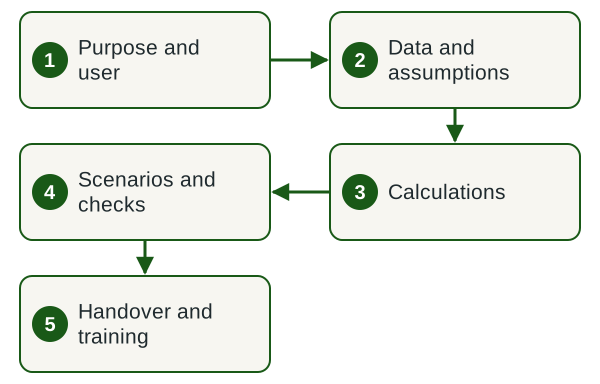
- Purpose and user Which decision the model supports and for whom.
- Data and assumptions Statements, plans, price lists, loan terms.
- Calculations Sales, costs, taxes and three linked statements.
- Scenarios and checks Scenarios, sensitivity and a check against the books.
- Handover and training We explain the model and how to update it.
Timing and fees
In our experience, a model takes a few weeks after we receive the input data. The fee is agreed per engagement and fixed in the contract. It depends on the number of products and entities, horizon, available data, lender requirements and scenarios.
What we need from you
- Financial statements and trial balances for recent periods.
- Budgets or plans, price lists and key contracts.
- A contact person to approve assumptions.
What you receive
- Forecast P&L, cash flow and balance sheet with NPV, IRR, payback and break-even.
- Scenarios, an assumptions memo and update instructions.
Rules the work relies on
- Art. 2(3) of Law No. 1560-XII — investment projects are documented in planning and calculation documents.
- Para. 136.1 of the Tax Code of Ukraine — standard corporate income tax rate of 18%.
- Subpara. (a), para. 193.1 of the Tax Code — standard VAT rate of 20%.
- National Accounting Standard 1 — structure of the financial statements the model follows.
Why use a contracted team
Typical errors: an unbalanced balance sheet, overstated sales, or VAT and seasonality missing from the cash flow, so a cash gap appears after the loan is drawn. At Key Solutions the tax block follows the Tax Code and the numbers are checked against your books. Scope and responsibility are fixed in the contract.
Why Key Solutions
- Company
- ТОВ «АУДИТОРСЬКА ФІРМА «КЕЙ СОЛЮШНЗ», a Ukrainian limited liability company, EDRPOU code 39610085. Company details are public in the Unified State Register (ЄДР).
- Contract
- We work under a contract: scope, timing and liability are fixed before the work starts. Client information is protected by professional secrecy (Art. 11 of Law No. 2258-VIII).
- Group
- We are part of Innova Consulting Group: legal matters are handled by legal.ua, crypto-asset taxation by crystal.tax.
- Office
- Our office is at 77 Velyka Vasylkivska St., Kyiv. We serve clients across Ukraine remotely. The specialists who run projects are listed on the Our employees page.
Frequently asked questions
What is a financial business model?
It is a spreadsheet that links assumptions about sales, costs, investment and funding to a forecast of profit, cash flow and the balance sheet. Change one assumption and the model shows the new result at once. It is used for planning, talks with banks and investors and business valuation.
How does a financial model differ from a budget or business plan?
The model tests whether goals are achievable and shows the effect of different scenarios. The budget fixes the plan for specific months and is the basis for budget-vs-actual analysis. A business plan describes the market, product and team, and the financial model provides its numbers.
Who needs a financial model: the bank, the investor or the owner?
All three, with different focus. A bank looks at cash flow and debt service capacity, an investor at returns and equity value, and the owner at break-even and funding needs. We agree the purpose of the model at the first meeting.
Can we use a ready-made template?
A template works as a sheet structure. Your business logic, tax regime, payment terms and seasonality still have to be built in, and that is where most errors appear. We therefore build the model on your own data.
Which metrics does the model calculate?
Revenue, gross and net profit, EBITDA, monthly cash flow, break-even, NPV, IRR and simple and discounted payback. For a bank we add a debt service coverage ratio; for a deal, a business valuation.
How much does a financial model cost?
The fee is agreed per engagement. It depends on the number of business lines and entities, horizon and time step, available historical data, lender or investor requirements and the number of scenarios. Scope and fee are fixed in the contract after the first consultation.
Related services
Order a financial model
Tell us who the model is for. We will reply with the structure, timeline and fee.
Book a consultation Order the service +38 (068) 777-14-74 Telegram WhatsApp