

Accounting and reporting for a Spanish SL means keeping the Diario and the Inventarios y Cuentas anuales books with electronic legalisation at the Registro Mercantil, filing quarterly IVA (VAT) and IRPF withholding returns by the 20th of the month after each quarter, paying corporate income tax (Impuesto sobre Sociedades) instalments and the annual return, paying Seguridad Social contributions for employees, and preparing annual accounts within 3 months, approving them within 6 months and depositing them with the registry together with the beneficial ownership declaration. Key Solutions coordinates this work for owners from Ukraine: the books and filings are handled by a Spanish accountant (gestoría), while we set the tasks, control deadlines and figures, and prepare owner reporting.
Request a tailored proposal Telegram
In brief
- For: owners from Ukraine who have or plan a Sociedad Limitada (SL) in Spain, and groups where the Spanish company works alongside a Ukrainian LLC.
- What we do: take over the books from the previous accountant, set up a deadline calendar, control IVA, withholding, corporate tax, contributions and annual accounts, prepare the company for audit where it is mandatory, and give the owner clear reporting.
- Who signs: a Spanish accountant keeps the books and files the returns, the company's directors (administradores) prepare and sign the annual accounts, and a mandatory audit is performed by a Spanish auditor. The directors file the beneficial ownership declaration.
- Fees: a tailored proposal after a short description of the company, with no public price list.
- To start: tell us whether the company is already entered in the Registro Mercantil, whether it has a NIF and employees, how many transactions it has per month and who keeps the books now.
What Spanish law requires from an SL
Every business in Spain keeps orderly accounts that allow all transactions to be followed in chronological order, and must keep two books: the Diario (journal) and the Inventarios y Cuentas anuales book (Art. 25, Commercial Code). Entries are made in euro. Responsibility for the books stays with the company even when they are kept by an outside accountant (Art. 25.2), so a director based in Ukraine needs to see what was filed on behalf of the SL and when.
| Obligation | What and when | Legal basis |
|---|---|---|
| Accounting books | Diario for every transaction day by day; Inventarios y Cuentas anuales for the opening balance, trial balances at least quarterly, the year-end inventory and the annual accounts | Arts. 25, 28, Commercial Code |
| Legalisation of books | All mandatory books, including the minutes book and the register of members, are legalised electronically at the Registro Mercantil within 4 months of the year end | Art. 18, Law 14/2013 |
| IVA (VAT) | Quarterly return within the first 20 calendar days of the following month; the Q4 return by 30 January together with the annual summary return | Art. 71, VAT Regulation |
| Withholding (retenciones) | IRPF withheld from salaries and other payments is declared and paid within the first 20 days of April, July, October and January; the annual withholding return is filed in January | Art. 108, IRPF Regulation |
| Corporate income tax (IS) | Instalments within the first 20 days of April, October and December; annual return within 25 days after the 6 months following the period end (1–25 July for a calendar year) | Arts. 40, 124, Law 27/2014 |
| Seguridad Social | Employer registration before starting activity, affiliation and registration (alta) of each employee; contributions are paid within the month following the month they accrue | Arts. 138–139 LGSS; Art. 56 RD 1415/2004 |
| Annual accounts | Prepared within 3 months of the year end, approved by the general meeting within 6 months, deposited with the Registro Mercantil within one month of approval | Arts. 253, 164, 279, Capital Companies Act |
| Beneficial owners | Beneficial ownership sheet (hoja de titularidad real) filed with the deposit of annual accounts; after any change, a new declaration at the Registro Mercantil within 10 days | RD 609/2023; Art. 4, Law 10/2010 |
Deadlines follow the consolidated BOE texts as of 9 October 2026: Código de Comercio, Ley 14/2013, Reglamento del IVA, Reglamento del IRPF, Ley 27/2014 del Impuesto sobre Sociedades, Ley General de la Seguridad Social, Ley de Sociedades de Capital, RD 609/2023.
Deadline calendar for a Spanish SL
Most tax deadlines of an SL are quarterly and fall within the first 20 days of the month after the quarter. The calendar below assumes a calendar financial year, quarterly IVA and employees.
| When | What to file or pay |
|---|---|
| 1–20 April, July, October | quarterly IVA return; quarterly IRPF withholding |
| 1–30 January | Q4 IVA and the annual IVA summary; Q4 withholding (by 20 January) and the annual withholding return |
| 1–20 April, October, December | corporate tax instalments (pagos fraccionados) |
| monthly | Seguridad Social contributions for the previous month |
| by 31 March | directors prepare the annual accounts, management report and proposed allocation of results |
| by 30 April | legalisation of last year's books at the Registro Mercantil |
| by 30 June | approval of the annual accounts by the general meeting |
| 1–25 July | annual corporate tax return and payment |
| one month after approval | deposit of the annual accounts and beneficial ownership sheet at the Registro Mercantil |
Monthly IVA (within the first 30 days of the following month, January by the end of February, because these companies keep their IVA books through SII: Arts. 62.6 and 71.4, VAT Regulation) is mandatory for companies whose turnover exceeded EUR 6,010,121.04 in the previous year and for those in the monthly VAT refund scheme (Art. 71.3, VAT Regulation); companies above that turnover also file withholding monthly (Art. 108.1, IRPF Regulation). Other companies may opt for monthly IVA, and that choice is irrevocable.
IVA: quarters, rates and the annual summary
The standard IVA rate is 21 %, with reduced rates of 10 % and 4 % (Arts. 90–91, Law 37/1992). The law sets no turnover threshold for VAT registration of a local business: a company carrying on activity files periodic returns from the start, including for quarters with no transactions. Only businesses making exclusively exempt supplies are released from this duty (Art. 71.1, VAT Regulation).
- the return period is the calendar quarter; monthly returns are mandatory for large companies and in the monthly refund scheme;
- the Q4 return is filed by 30 January together with the annual summary (Art. 71.4 and 71.6);
- for sales of goods and electronic services to consumers in other EU countries, an annual threshold of EUR 10,000 applies, above which IVA follows the rules of the customer's country (Art. 73, Law 37/1992);
- from 1 December 2026 RDL 29/2026 changes reduced rates for housing transactions, so for companies in that sector we check the rate before invoicing.
VeriFactu. Invoicing software must meet the requirements of RD 1007/2023: corporate taxpayers by 1 January 2027, other taxpayers, including branches of foreign companies, by 1 July 2027. Companies keeping their IVA books through the Immediate Supply of Information system (SII) are outside these rules (RD 1007/2023, Art. 3 and Final Provision 4). For an SL with a Ukrainian owner this means compliant invoicing software or an accountant's system in place before 2027.
Corporate income tax: rates, instalments and the return
The standard Impuesto sobre Sociedades rate is 25 %. A new company with an economic activity pays 15 % in its first period with a positive tax base and the following one. For periods starting in 2026, micro companies with turnover below EUR 1 million pay 19 % on the first EUR 50,000 of the base and 21 % on the rest, and small companies with turnover below EUR 10 million pay 23 % (Art. 29 and Transitional Provision 44, Law 27/2014). Instalments are paid within the first 20 days of April, October and December, and the annual return is filed within 25 calendar days after the 6 months following the period end. Spanish tax matters and the owner's taxes are handled by crystal.tax, a group company.
Payroll, Seguridad Social and withholding
An employer registers with the Régimen General de la Seguridad Social before starting activity and registers each employee (afiliación and alta); a late alta has no retroactive effect (Arts. 138–140 LGSS). Contributions are paid within the month following the month they accrue (Art. 56, RD 1415/2004). IRPF withheld from salaries is declared and paid quarterly, and in January the company files an annual withholding return listing the recipients (Art. 108, IRPF Regulation).
Annual accounts, deposit and audit
The directors prepare the annual accounts (cuentas anuales), the management report and the proposed allocation of results within 3 months of the year end (Art. 253, Capital Companies Act). The general meeting approves the accounts within the first 6 months of the year (Art. 164), and within one month of approval they are deposited with the Registro Mercantil of the company's registered office (Art. 279). A company that for two consecutive years meets two of three conditions — total assets up to EUR 2,850,000, turnover up to EUR 5,700,000, up to 50 employees — may use the abridged balance sheet and statement of changes in equity, without a cash flow statement (Art. 257).
If the accounts are not deposited on time, the Registro Mercantil records no new documents for the company while the default lasts, apart from a few exceptions such as a director's removal or liquidation (Art. 282). In addition, the ICAC may impose a fine of EUR 1,200 to 60,000, rising to EUR 300,000 per year of delay for companies with turnover above EUR 6,000,000 (Art. 283). For an owner in Ukraine, a closed registry sheet means a new director, a new address or statute changes cannot be registered until the accounts are filed.
| When an SL is exempt from statutory audit | Condition: at least 2 of 3 for two consecutive years |
|---|---|
| Total assets | no more than EUR 2,850,000 |
| Net turnover | no more than EUR 5,700,000 |
| Average number of employees | no more than 50 |
Thresholds: Art. 263, Capital Companies Act. In its first year a company is exempt if it meets two of the three conditions at that year end (Art. 263.3). The audit is performed by a Spanish auditor. Key Solutions prepares the books, the document pack and explanations for the audit and coordinates with the auditor until the accounts are approved.
Beneficial ownership register
A beneficial owner of a Spanish company is an individual who directly or indirectly owns or controls more than 25 % of the capital or voting rights, or otherwise controls its management (Art. 4.2(b), Law 10/2010). Where there is no such person, the director is treated as the beneficial owner (Art. 4.1, RD 609/2023). An SL files the beneficial ownership sheet with the deposit of its annual accounts, and after any change of beneficial owners the directors file a new declaration with the Registro Mercantil within 10 days of learning of it. A missing declaration closes the company's registry sheet in the same way as unfiled accounts (RD 609/2023). We prepare the ownership structure data, including holdings through Ukrainian companies, and make sure the declaration is filed on time.
Handover of an SL's books
A change of accountant is the most common reason clients come to us: the previous gestoría stopped responding, the owner cannot see the numbers, or the annual accounts were not deposited. We take the books over against a checklist:
- the Diario and Inventarios y Cuentas anuales books, a trial balance at the handover date, proof of legalisation of the books;
- the latest approved annual accounts, minutes of meetings and proof of deposit at the Registro Mercantil;
- IVA, withholding and corporate tax returns with filing receipts for recent periods;
- bank statements for all accounts, issued and received invoice registers, access to the tax portal;
- payroll and Seguridad Social records, if there are employees;
- a check of the beneficial ownership declaration and of the company data at the Registro Mercantil.
Discrepancies found during the handover are recorded in a separate memo with a correction plan.
What the service includes
- diagnostics: IVA regime, corporate tax rate, audit duty, the status of past accounts and beneficial ownership filings;
- selecting and setting up the work with a Spanish accountant: scope, document flow, quarter-close schedule, access rights;
- control of IVA, withholding and corporate tax instalments before each filing date;
- control of the annual accounts, legalisation of books, approval and deposit at the Registro Mercantil;
- audit preparation and coordination with the auditor where an audit is mandatory;
- VeriFactu readiness: choice of invoicing software and invoicing procedure before 2027;
- management reporting for the owner: profit, cash flows, taxes payable;
- a financial statements pack for the Ukrainian owner's CFC report, IFRS reporting or consolidation with a Ukrainian LLC on request.
How we work
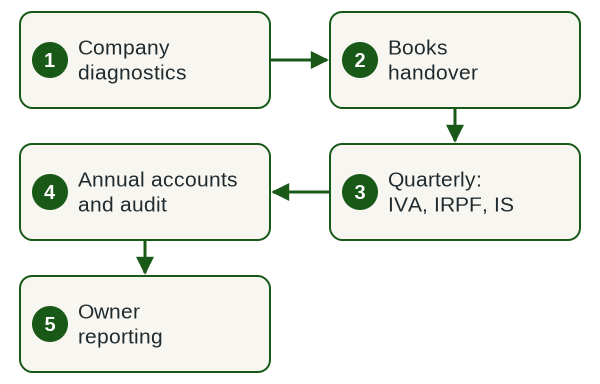
- Diagnostics. We obtain a Registro Mercantil extract, the latest accounts and returns, and determine the IVA regime, corporate tax rate and the company's obligations.
- Books handover. We take over the books from the previous accountant against a checklist and record discrepancies.
- Quarterly cycle. Documents, quarter close, IVA and withholding by the 20th, corporate tax instalments, monthly contributions.
- Annual reporting. Cuentas anuales, legalisation of books, audit where required, approval, deposit with the beneficial ownership sheet, annual corporate tax return.
- Owner reporting. Management report, CFC and consolidation pack.
Reporting for the owner in Ukraine
For an owner who is a Ukrainian tax resident, a Spanish SL is often a controlled foreign company: a stake above 50 %, or above 10 % where Ukrainian residents together hold 50 % or more (sub-para. 39-2.1.2 of the Tax Code of Ukraine). Certified copies of the company's financial statements are attached to the CFC report (sub-para. 39-2.5.2), so the Spanish annual accounts are needed in Ukraine as well. We prepare this pack together with our service for financial reporting for foreign companies.
Dividends paid by a Spanish company to a non-resident are subject to 19 % withholding tax (Art. 25.1(f), TRLIRNR). As of the update date, Ukraine and Spain apply the Spain–USSR Convention of 1 March 1985: dividends at no more than 18 %, interest taxed only in the recipient's country, royalties at no more than 5 % (text of the convention, Spanish Ministry of Finance). A new Ukraine–Spain convention was signed in 2020, but the Spanish Ministry of Finance does not list it as published in the BOE as of the update date, so we do not apply its rates. The owner's taxes and CFC report are handled by crystal.tax.
Registration, address and residence: other group companies
SL registration, a registered address in Spain and changes of director are arranged by regserv.biz: company registration in Spain. A foreign investor's contribution to the capital of a Spanish company is declared to the Registro de Inversiones on form D-1A within one month of the investment; where a Spanish notary authorised the transaction, the notary files it (Orden ECM/57/2024). Registering a company gives no right to live in Spain by itself: the entrepreneur residence permit requires a favourable ENISA report on the business plan, and other routes have their own conditions. Immigration matters are handled by legal.ua: immigration to Spain. An overview of entering the Spanish market is on innovacg.com. Key Solutions joins once the company exists or is being registered and is responsible for accounting and reporting.
What we need from you
- the company name and NIF, or the planned registration date;
- the latest annual accounts and tax returns, if the company is already trading;
- bank statements and a list of main counterparties;
- the number of employees and their contract types;
- contact details of the previous accountant for the handover;
- the list of owners and their tax residence for the beneficial ownership declaration and the CFC pack.
We accept documents electronically and never need your bank passwords.
Result
- the SL's books closed every quarter, IVA, withholding and corporate tax instalments filed on time;
- books legalised, annual accounts prepared, approved and deposited at the Registro Mercantil with the beneficial ownership sheet;
- the annual corporate tax return filed in July;
- an audit report where the company is subject to statutory audit;
- a management report and CFC pack for the owner;
- a deadline calendar for the following year.
Legal basis
Spanish rules behind the work (consolidated BOE texts as of 09.10.2026)
- Código de Comercio — Art. 25 (mandatory books), Art. 28 (content of books), Art. 30 (6-year retention);
- Ley de Sociedades de Capital, RDL 1/2010 — Art. 164 (approval), Art. 253 (preparation), Art. 257 (abridged forms), Art. 263 (audit), Art. 279 (deposit), Arts. 282–283 (registry closure and fines);
- Ley 14/2013 — Art. 18 (legalisation of books within 4 months);
- Ley 37/1992 del IVA — Arts. 73, 90, 91 (rates and EU distance sales threshold); Reglamento del IVA, RD 1624/1992 — Art. 71 (periods and deadlines);
- Ley 27/2014 del Impuesto sobre Sociedades — Art. 29 and TP 44 (rates), Art. 40 (instalments), Art. 124 (return);
- Reglamento del IRPF, RD 439/2007 — Art. 108 (withholding returns);
- Ley General de la Seguridad Social, RDL 8/2015 — Arts. 138–140; RD 1415/2004 — Art. 56 (contribution payment deadline);
- Ley 10/2010 — Art. 4 (beneficial owner); RD 609/2023 — beneficial ownership register;
- RD 1007/2023 — VeriFactu, deadlines 1.01.2027 and 1.07.2027;
- TRLIRNR, RDL 5/2004 — Art. 25 (non-resident withholding); Spain–USSR Convention of 1985;
- Tax Code of Ukraine — sub-paras. 39-2.1.2 and 39-2.5.2: controlling person and CFC report.
Why Key Solutions
- Turnkey, with no extra hassle
- We take the whole task: bookkeeping, reporting, deadlines and correspondence with local authorities. You make decisions and sign; we do the rest and contact you only when it matters.
- We handle the bureaucracy
- Queries from the tax office, the registry or a bank in the company's country: we prepare answers and documents with our local partner until the issue is closed.
- We see it through
- Your case stays on track, even when the process takes months. Spanish books and filings: a Spanish accountant; statutory audit: a Spanish auditor; annual accounts and the beneficial ownership declaration: the company's directors; coordination, control and owner reporting: Key Solutions.
- Boutique-level involvement
- A senior specialist runs your project personally, backed by 14 years of Innova group practice in 50+ countries. Group companies cover the rest: Spanish taxes and the owner's CFC matters — crystal.tax, company registration — regserv.biz, legal and immigration matters — legal.ua.
- Your affairs stay yours
- Information about your company, turnover, payroll and counterparties reaches neither competitors nor third parties. We disclose only what the law or a procedure requires, and the contract says so.
- Faster and right the first time
- Full involvement: your specialist learns your books, contracts and business, so documents and reports are ready on time with no rework. The group's 14 years of experience let us get right the first time what takes some firms three attempts.
FAQ
Can a Spanish SL be accounted for from Ukraine?
A Spanish company keeps its books in euro under the Commercial Code, and IVA, withholding and corporate tax returns are filed electronically with the Spanish tax agency. The books and filings are therefore handled by a Spanish accountant (gestoría), while responsibility for the books stays with the company. Key Solutions sets the tasks, controls deadlines and figures, and prepares owner reporting.
When does an SL file IVA returns?
Quarterly, within the first 20 calendar days of the month after the quarter; the Q4 return is due by 30 January together with the annual summary (Art. 71, VAT Regulation). Monthly filing is mandatory where turnover exceeded EUR 6,010,121.04 in the previous year. There is no turnover threshold for VAT registration of a local business, and a return is filed even for a quarter with no transactions.
What are the deadlines for an SL's annual accounts?
The directors prepare the annual accounts within 3 months of the year end, the general meeting approves them within 6 months, and they are deposited with the Registro Mercantil within one month of approval (Arts. 253, 164, 279, Capital Companies Act). The accounting books are legalised at the Registro Mercantil within 4 months of the year end (Art. 18, Law 14/2013).
What happens if the annual accounts are not filed?
The Registro Mercantil records no new documents for the company until the accounts are filed, so a new director, address or statute change cannot be registered (Art. 282). The ICAC may impose a fine of EUR 1,200 to 60,000, or up to EUR 300,000 per year of delay for companies with turnover above EUR 6 million (Art. 283).
Does my SL need a statutory audit?
No, if for two consecutive years the company meets at least two of three conditions: total assets up to EUR 2,850,000, net turnover up to EUR 5,700,000, up to 50 employees (Art. 263, Capital Companies Act). In the first year, meeting two conditions at year end is enough. Otherwise the audit is performed by a Spanish auditor.
Who declares the beneficial owners of an SL, and when?
The directors file the beneficial ownership sheet with the deposit of the annual accounts, and after any change of beneficial owners a new declaration with the Registro Mercantil within 10 days (RD 609/2023). A beneficial owner is an individual with ownership or control above 25 %; if there is none, the director is treated as the beneficial owner.
What is VeriFactu and when does it apply?
VeriFactu sets requirements for invoicing software under RD 1007/2023. Corporate taxpayers must use compliant software by 1 January 2027, and other taxpayers, including branches of foreign companies, by 1 July 2027. Companies keeping their IVA books through the SII system are outside these rules.
How do we switch from our current gestoría?
We collect the Diario and Inventarios y Cuentas anuales books, proof of legalisation, the latest approved accounts with proof of deposit, IVA, withholding and corporate tax returns, Seguridad Social records and tax portal access from the previous accountant. Discrepancies are recorded in a memo with a correction plan, and then the quarterly cycle starts.
Does a Spanish SL give the owner a right to live in Spain?
Not automatically: company registration and residence permits are separate procedures. The entrepreneur residence permit requires a favourable ENISA report on the business plan, and other routes have their own conditions. Immigration matters are handled by legal.ua, and Key Solutions is responsible for the company's accounting and reporting.
How much does accounting for a Spanish SL cost?
We prepare a tailored proposal after a short description of the company. The scope depends on the number of transactions and accounts, the IVA regime, headcount, audit duty, the state of prior years' books, and whether CFC or consolidation reporting is needed.
Related services
Request a tailored proposal for your SL's accounting
Tell us whether the company is already entered in the Registro Mercantil, whether it has employees, how many transactions it has per month and who keeps the books now. We will reply with the scope, the split of roles and how we start.
Request a tailored proposal Telegram WhatsApp