

Accounting and reporting for a German GmbH means double-entry bookkeeping under the Commercial Code (HGB), annual accounts within 3 months of the year end (up to 6 months for small companies), publication in the Unternehmensregister within 12 months, a mandatory audit for medium-sized and large companies, advance VAT returns by the 10th day after each period, a monthly wage tax return, social security contributions, advance payments of corporate and trade tax, annual tax returns and beneficial ownership data in the Transparenzregister. Key Solutions coordinates this work for owners from Ukraine: the books and tax returns are handled by a German tax adviser (Steuerberater) or accounting firm, the audit is signed by a German Wirtschaftsprüfer, and we set the tasks, control deadlines and figures and prepare reporting for the owner.
Request a tailored proposal Telegram
In brief
- For whom: owners from Ukraine who have or plan a German limited liability company (GmbH or UG (haftungsbeschränkt)) or a registered branch of a foreign company (Zweigniederlassung), and groups where the German company sells goods or services in the EU on behalf of a Ukrainian business.
- What we do: take over the books from the previous accountant, set up a deadline calendar, control VAT, payroll, contributions and advance payments, prepare the company for the year-end close and audit, monitor publication of the accounts and the Transparenzregister, and give the owner clear reporting.
- Who signs: the books and tax returns are handled by a German Steuerberater or accounting firm, the audit opinion is signed by a Wirtschaftsprüfer, and the annual accounts are prepared and signed by the company's managing directors (Geschäftsführer).
- Cost: a tailored proposal after a short description of the company, with no public price list.
- How to start: send us the incorporation date, the legal form (GmbH or UG), whether the company is VAT registered and has employees, its turnover and balance sheet total for the last year, and who keeps the books now.
What German law requires from a GmbH
A GmbH or UG is a merchant under the HGB, so it keeps books in line with proper accounting principles (§ 238 HGB) and prepares a balance sheet and profit and loss account every year (§ 242 HGB). For corporations the annual accounts are extended by notes (Anhang) and a management report (Lagebericht) (§ 264 HGB). Within one month of starting business the company notifies the municipality and, for VAT-relevant activity, the tax office (§ 138 Fiscal Code AO). Books and annual accounts are kept for 10 years, posting vouchers for 8 years and business correspondence for 6 years (§ 257 HGB, § 147 AO).
| Obligation | What and when | Rule |
|---|---|---|
| Bookkeeping | Double entry under the HGB, balance sheet and P&L every year; books kept 10 years, vouchers 8 years | § 238, 242, 257 HGB; § 147 AO |
| Annual accounts | Prepared within 3 months of the year end; small companies up to 6 months, with no management report | § 264 HGB |
| Audit | Mandatory for all corporations except small ones; auditor: a Wirtschaftsprüfer or audit firm | § 316, 319 HGB |
| Publication | Filed electronically with the Unternehmensregister, in German, within 12 months of the balance sheet date | § 325, 326 HGB |
| Corporate tax | 15% plus a 5.5% solidarity surcharge on the tax; advance payments on 10 March, 10 June, 10 September, 10 December | § 23 KStG; § 4 SolZG; § 37 EStG |
| Trade tax | 3.5% of the base × the municipal multiplier (Hebesatz); advance payments on 15 February, 15 May, 15 August, 15 November | § 11, 16, 19 GewStG |
| VAT | Advance return by the 10th day after the period (month or quarter), annual return; B2B e-invoicing phased in over 2027–2028 | § 18, 27 UStG |
| Payroll | Wage tax return and payment by the 10th day after the period; social security contributions by the third-last banking day of the month | § 41a EStG; § 23 SGB IV |
| Beneficial owners | Data on ultimate owners reported to the Transparenzregister without delay and updated on any change | § 3, 20 GwG |
Deadline calendar for a German GmbH
Some deadlines recur every month or quarter, others follow the end of the financial year. Below are the statutory deadlines as of 09.10.2026 for a company whose financial year is the calendar year.
| When | What to file or pay | Source |
|---|---|---|
| 1 month after start | Notice of business start to the municipality and, for VAT-relevant activity, to the tax office; tax registration data in the official electronic format | § 138 AO |
| By the 10th | Advance VAT return and payment for the previous month or quarter; wage tax return and payment; withholding tax on dividends paid in the previous month | § 18 UStG; § 41a EStG; § 44 EStG |
| By the 25th | EC sales list (Zusammenfassende Meldung) for intra-EU supplies of goods in the previous month; quarterly where such supplies did not exceed €50,000 in the current quarter or any of the four preceding quarters | § 18a UStG |
| Third-last banking day of the month | Social security contributions on the current month's wages | § 23 SGB IV |
| 10.03, 10.06, 10.09, 10.12 | Corporate tax and solidarity surcharge advance payments set by the tax office | § 37 EStG with § 31 KStG |
| 15.02, 15.05, 15.08, 15.11 | Trade tax advance payments to the municipality | § 19 GewStG |
| 31 March | Annual accounts and management report of a medium-sized or large company for the previous year | § 264 HGB |
| 30 June | Annual accounts of a small company, where consistent with orderly business conduct | § 264 HGB |
| 31 July | Annual corporate tax, trade tax and VAT returns, if the company files them itself | § 149 AO |
| 31 December | Publication of the previous year's annual accounts in the Unternehmensregister | § 325 HGB |
| End of February of the second year | Annual tax returns prepared by a tax adviser; the tax office may request them earlier | § 149 AO |
Annual accounts, company size and audit
The scope of the annual accounts, the preparation deadline, the audit requirement and the extent of publication depend on the company's size class under § 267 and § 267a HGB. The class is set by three criteria: balance sheet total, revenue for 12 months and average number of employees. A company falls into a class if it does not exceed two of the three thresholds on two consecutive balance sheet dates; a newly formed company is classified on its first balance sheet date (§ 267 HGB).
| Class | Thresholds (two of three) | What it means |
|---|---|---|
| Micro (Kleinst) | Balance sheet up to €450,000, revenue up to €900,000, up to 10 employees | Notes may be omitted if the required data is shown below the balance sheet; only the balance sheet is published, and it may be deposited with the register instead; no mandatory audit |
| Small | Balance sheet up to €7,500,000, revenue up to €15,000,000, up to 50 employees | Up to 6 months to prepare, no management report; balance sheet and notes are published; no mandatory audit |
| Medium-sized | Balance sheet up to €25,000,000, revenue up to €50,000,000, up to 250 employees | 3 months to prepare, management report, mandatory audit; auditor: a Wirtschaftsprüfer or sworn accountant (vereidigter Buchprüfer) |
| Large | Above the medium-sized thresholds | Full reporting and publication, mandatory audit by a Wirtschaftsprüfer |
The thresholds come from the current text of § 267 and § 267a HGB, the micro and small company rules from § 264 and § 326 HGB, the audit requirement from § 316(1) HGB and the auditor requirements from § 319 HGB (gesetze-im-internet.de). Micro and small companies have no statutory audit, yet audited accounts are often requested by a bank, an investor or a parent company for consolidation. That is why we plan the year-end schedule from the first year.
Publication of accounts and penalties
The managing directors file the annual accounts with the Unternehmensregister electronically and in German within one year of the balance sheet date (§ 325(1), (1a) HGB). A small company publishes the balance sheet and notes without the P&L data; a micro company publishes only the balance sheet and may choose deposit instead of publication if it confirms to the register that it meets the thresholds (§ 326 HGB).
- for late publication the Federal Office of Justice (Bundesamt für Justiz) opens proceedings with an administrative fine of €2,500 to €25,000 against the directors or the company itself (§ 335 HGB);
- proceedings may start even if the accounts have not yet been prepared or the audit not yet commissioned;
- for a late tax return the tax office may charge a late filing surcharge; it becomes mandatory if the return is not filed within 14 months of the year end (§ 152 AO).
A company that has missed one or more years is brought back on schedule by restoring the books, preparing the missing annual accounts and filing the returns. We plan this work separately after a diagnostic.
VAT in Germany: returns, reports and e-invoicing
The standard VAT (Umsatzsteuer) rate in Germany is 19% and the reduced rate is 7% (§ 12 UStG). The advance return is filed electronically by the 10th day after the end of the period, and the tax is paid by the same date. The period is the calendar quarter, or the month if the previous year's VAT exceeded €9,000. For a new business the law sets a monthly period in the year of start and the following year; for 2021–2026 the period is determined by the projected annual tax instead (§ 18(1), (2) UStG).
- on application the tax office extends the advance return deadline by one month (§ 46 UStDV);
- an annual VAT return is filed separately after the year end (§ 18(3) UStG);
- the small business exemption applies with turnover up to €25,000 in the previous year and up to €100,000 in the current year (§ 19 UStG); the old €22,000 and €50,000 thresholds no longer apply;
- an e-invoice is an invoice in a structured format under the European standard (§ 14(1) UStG); paper and PDF invoices between businesses remain allowed for 2025–2026 transactions, in 2027 only if the previous year's turnover did not exceed €800,000, and from 2028 e-invoices are mandatory for all domestic B2B transactions (§ 27(38) UStG).
VAT registration and the German company's tax questions are covered by crystal.tax: VAT registration in Germany. We are responsible for the books, timely returns and the switch to e-invoicing in the accounting system.
Corporate tax and trade tax: what matters for the books
A GmbH pays corporate tax (Körperschaftsteuer) at 15% plus a solidarity surcharge of 5.5% of the tax. The law already provides for a lower rate: 14% in 2028, then one point less each year down to 10% from 2032 (§ 23(1) KStG). Trade tax (Gewerbesteuer) is 3.5% of the base multiplied by the municipal rate (Hebesatz); a minimum multiplier of 280% applies from 2027 (§ 11, § 16, § 36 GewStG). The total burden on profit therefore depends on the municipality where the company is registered.
- corporate tax advance payments fall on 10 March, 10 June, 10 September and 10 December, trade tax on 15 February, 15 May, 15 August and 15 November; the amounts are set by the tax office and the municipality based on the latest assessment;
- the balance sheet and P&L with account-level detail are transmitted to the tax office electronically in the official format, the so-called E-Bilanz (§ 5b EStG);
- we set up the accounting policy and chart of accounts so that the E-Bilanz is generated from the same data as the HGB annual accounts.
Payroll and employees
An employer files a wage tax return (Lohnsteuer-Anmeldung) and pays the withheld tax by the 10th day after the period. The period is the month; the quarter if the previous year's wage tax was between €1,080 and €5,000; the year if it did not exceed €1,080 (§ 41a EStG). Social security contributions are paid in the estimated amount by the third-last banking day of the month in which the work was done (§ 23 SGB IV).
For a director and employees from Ukraine, payroll is linked to their residence status: the Blue Card, skilled worker permits and temporary protection each come with conditions checked by the foreigners authority. We keep payroll consistent with the terms of each permit.
Transparenzregister: beneficial ownership
German legal entities obtain, keep, update and report without delay to the Transparenzregister the data on their beneficial owners (§ 20(1) GwG). A beneficial owner is a natural person who directly or indirectly holds more than 25% of the capital, controls more than 25% of the voting rights or exercises control in a comparable way (§ 3(2) GwG). For a GmbH owned by a Ukrainian LLC, the beneficial owner is usually the individual who controls that LLC. We prepare the ownership chain and reconcile it with the data given to the bank and the auditor.
Branch of a foreign company (Zweigniederlassung)
A Ukrainian company can operate in Germany through a branch. It is registered with the register court at the branch's location with a German address (§ 13d HGB). For a branch of a foreign corporation the law requires publication in Germany, in German, of the head office's accounts as prepared, audited and disclosed under its home law (§ 325a HGB). We keep the branch's books with a separate package for consolidation with the Ukrainian company.
Taking over the books of a German company
A handover is needed when the previous accountant stops responding, the year-end close drags on or the owner cannot see the numbers. We take over the books against a checklist so that the new German adviser starts without a gap.
- trial balance and general ledger at the handover date, source documents for the current year;
- the latest annual accounts, proof of publication in the Unternehmensregister, the audit opinion if there was one;
- advance and annual VAT returns, EC sales lists, tax office notices on advance payments;
- corporate tax and trade tax returns with the assessments of the tax office and the municipality;
- statements for all bank accounts, contracts with counterparties, access to the ELSTER tax portal;
- payroll calculations, wage tax returns and proof of social security contributions, if there are employees;
- a Transparenzregister extract and the shareholder list from the Handelsregister.
Discrepancies found during the handover are recorded in a separate report with a correction plan.
What the service includes
- diagnostic: HGB size class, status of accounts and publications for past years, VAT registration, return periods, Transparenzregister;
- selecting and setting up work with a German tax adviser and, where needed, a Wirtschaftsprüfer: brief, document flow, monthly close schedule, access rights;
- control of advance VAT returns, EC sales lists, wage tax and social security contributions before the filing date;
- control of corporate tax and trade tax advance payments;
- HGB year-end close, audit coordination, control of annual returns and publication in the Unternehmensregister;
- preparing the accounting system for e-invoicing in 2027–2028;
- management reporting for the owner: profit, cash flow, taxes payable;
- a financial statements package for the Ukrainian owner's CFC report, consolidation with the Ukrainian company on request.
How we work
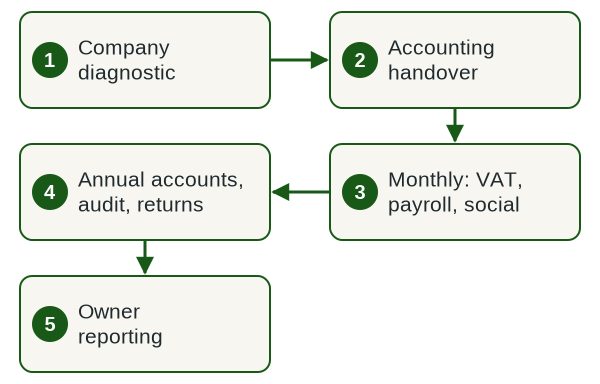
- Diagnostic. We obtain the Handelsregister extract, the latest annual accounts and returns, and check the size class, VAT and publications.
- Accounting handover. We take over the books from the previous accountant against a checklist and record discrepancies.
- Monthly cycle. Documents, month-end close, payroll and contributions, VAT returns, advance payments.
- Annual cycle. HGB annual accounts, audit where needed, E-Bilanz and annual returns, publication.
- Owner reporting. Management report, CFC and consolidation package.
Reporting for an owner in Ukraine
For an owner who is tax resident in Ukraine, a German company is often a controlled foreign company: a stake above 50%, or above 10% where Ukrainian residents together hold 50% or more (subpara. 39-2.1.2 of the Tax Code of Ukraine). The CFC report is accompanied by certified copies of the company's financial statements (subpara. 39-2.5.2), so the German annual accounts are needed in Ukraine as well. We prepare the accounts and the CFC package together with our reporting for foreign companies service.
On dividends a GmbH withholds 25% tax plus the solidarity surcharge and pays it over by the 10th of the following month (§ 43a, § 44 EStG). A foreign corporate recipient can reclaim 2/5 of the tax withheld (§ 44a(9) EStG). The Ukraine–Germany double tax treaty of 03.07.1995 is in force: dividends are taxed at no more than 5% where the recipient is a company holding at least 20%, and no more than 10% otherwise (art. 10 treaty on zakon.rada.gov.ua). A new treaty was signed on 19.05.2026 and has not yet entered into force. The owner's tax, dividends and residence are covered by crystal.tax: company taxes in Germany.
Registration and residence: other group companies
GmbH or UG registration in Germany and changes of director or address are arranged by regserv.biz: company registration in Germany. Registering a company does not by itself give a right to live in Germany. A self-employment residence permit under § 21 of the Residence Act is granted where the business serves an economic interest and is financed, and the decision rests with the foreigners authority (§ 21 AufenthG). Ukrainian citizens without a German residence permit apply with a national D visa through a consulate, as Ukraine is not on the § 41 AufenthV list. Those who already hold a residence permit, including temporary protection (§ 24 AufenthG), may apply in Germany (§ 39 AufenthV). Immigration matters are handled by legal.ua: residence permit in Germany. An overview of entering the German market is on innovacg.com. Key Solutions joins once the company exists or is being registered and is responsible for accounting and reporting.
What we need from you
- company name and Handelsregister number (HRB), or the planned incorporation date;
- the latest annual accounts, VAT and corporate tax returns, if the company is already trading;
- bank statements and a list of main counterparties, including those in other EU countries;
- balance sheet total, revenue and headcount for the last two years, to determine the size class;
- number of employees and their immigration status;
- contacts of the previous accountant or tax adviser and of the auditor, if any;
- the owners and their tax residence, for the Transparenzregister and the CFC package.
We accept documents electronically. We do not need bank passwords.
Result
- books closed monthly, VAT, wage tax and contributions filed and paid on time;
- corporate tax and trade tax advance payments made on schedule;
- HGB annual accounts prepared on time and audited where required;
- annual returns filed, accounts published in the Unternehmensregister;
- Transparenzregister data matches the actual structure;
- management report and CFC package for the owner;
- a deadline calendar for the next year.
Legal basis
German rules the work relies on (current texts on gesetze-im-internet.de as of 09.10.2026)
- Commercial Code HGB — § 238, 242 (books and annual accounts), § 257 (retention), § 264 (preparation deadlines), § 267, 267a (size classes), § 316, 319 (audit), § 325, 325a, 326 (publication), § 335 (fines), § 13d (branch);
- Fiscal Code AO — § 138 (business start notice), § 147 (retention), § 149 (return deadlines), § 152 (late filing surcharge);
- VAT Act UStG — § 12 (rates), § 14 (e-invoice), § 18, 18a (returns), § 19 (small businesses), § 27(38) (e-invoicing transition); § 46 UStDV (deadline extension);
- Corporate Tax Act KStG — § 23 (15% rate and reduction to 10%), § 31 (advance payments); § 4 SolZG (solidarity surcharge);
- Trade Tax Act GewStG — § 11, 16, 36 (base, municipal multiplier), § 19 (advance payments);
- Income Tax Act EStG — § 5b (E-Bilanz), § 37 (advance payments), § 41a (wage tax), § 43a, 44, 44a (dividend withholding tax); § 23 SGB IV (social security due dates);
- Anti-Money Laundering Act GwG — § 3 (beneficial owner), § 20 (Transparenzregister);
- Ukraine–Germany double tax treaty of 03.07.1995 (zakon.rada.gov.ua) — arts. 10–12;
- Tax Code of Ukraine — subparas. 39-2.1.2 and 39-2.5.2: controlling person and CFC report.
Why Key Solutions
- Turnkey, with no extra hassle
- We take the whole task: bookkeeping, reporting, deadlines and correspondence with local authorities. You make decisions and sign; we do the rest and contact you only when it matters.
- We handle the bureaucracy
- Queries from the tax office, the registry or a bank in the company's country: we prepare answers and documents with our local partner until the issue is closed.
- We see it through
- Your case stays on track, even when the process takes months. German books and tax returns: a German tax adviser or accounting firm; audit: a German Wirtschaftsprüfer; annual accounts prepared and signed by the company's managing directors; coordination, control and owner reporting: Key Solutions.
- Boutique-level involvement
- A senior specialist runs your project personally, backed by 14 years of Innova group practice in 50+ countries. Group companies cover the rest: German taxes and the owner's CFC matters by crystal.tax, company registration by regserv.biz, legal and immigration matters by legal.ua.
- Your affairs stay yours
- Information about your company, turnover, payroll and counterparties reaches neither competitors nor third parties. We disclose only what the law or a procedure requires, and the contract says so.
- Faster and right the first time
- Full involvement: your specialist learns your books, contracts and business, so documents and reports are ready on time with no rework. The group's 14 years of experience let us get right the first time what takes some firms three attempts.
Frequently asked questions
Does a small GmbH need an audit?
A statutory audit applies to corporations other than small ones (§ 316(1) HGB). A small company does not exceed two of three thresholds: balance sheet €7,500,000, revenue €15,000,000, 50 employees (§ 267(1) HGB). An audit may still be needed if a bank, an investor or a parent company asks for it.
When are a GmbH's annual accounts prepared and published?
They are prepared within 3 months of the year end, or up to 6 months for small companies (§ 264(1) HGB), and published in the Unternehmensregister within 12 months of the balance sheet date (§ 325(1a) HGB). For late publication the Federal Office of Justice imposes a fine of €2,500 to €25,000 (§ 335 HGB).
How often are VAT returns filed in Germany?
The advance return is due by the 10th day after the period. The period is the quarter, or the month if the previous year's VAT exceeded €9,000 (§ 18 UStG). On application the tax office extends the deadline by one month (§ 46 UStDV). An annual VAT return follows the year end.
What is the corporate tax rate in Germany?
Corporate tax is 15% plus a 5.5% solidarity surcharge on the tax; from 2028 the rate falls by one point a year to 10% in 2032 (§ 23 KStG). Trade tax is added: 3.5% of the base multiplied by the municipal rate (§ 11, 16 GewStG). The owner's tax questions are covered by crystal.tax.
When does e-invoicing become mandatory?
For 2025–2026 transactions businesses may still issue paper and PDF invoices. In 2027 this is allowed only with previous-year turnover up to €800,000, and from 2028 e-invoices are mandatory for all domestic B2B transactions in Germany (§ 27(38) UStG).
How long must a German company keep its records?
Books, annual accounts and management reports for 10 years, posting vouchers for 8 years, and business correspondence received and sent for 6 years (§ 257(4) HGB, § 147(3) AO).
What is the Transparenzregister and who reports to it?
It is the register of beneficial owners. A GmbH obtains, updates and reports without delay the data on individuals who directly or indirectly hold more than 25% of the capital or votes or otherwise control the company (§ 3, § 20 GwG).
Can a German GmbH's books be managed from Ukraine?
The books and tax returns are handled by a German tax adviser or accounting firm, the audit is signed by a Wirtschaftsprüfer, and the annual accounts are prepared and signed by the managing directors. Key Solutions sets the tasks, controls deadlines and figures, coordinates the audit and prepares reporting for the owner, including the CFC package.
Does a German company give a right to residence?
Registering a GmbH does not by itself give a right to live in Germany. A self-employment permit under § 21 AufenthG requires an economic interest and financing; Ukrainian citizens without a German residence permit apply with a D visa through a consulate, while holders of a residence permit, including temporary protection (§ 24 AufenthG), may apply in Germany (§ 39 AufenthV). Immigration matters are handled by legal.ua; we are responsible for accounting and reporting.
How much does accounting support for a GmbH cost?
It depends on the number of transactions, employees, VAT registration, the size class, the state of the books for past years and whether an audit is needed. We prepare a tailored proposal after a short description of the company.
Related services
Request a tailored proposal for your German GmbH's accounting
Tell us the incorporation date, whether the company is VAT registered and has employees, its balance sheet total and revenue for the last year, and who keeps the books now. We will reply with the scope of work, the split of roles and how we start.
Request a tailored proposal Telegram WhatsApp