

Accounting and reporting for a UK company means keeping accounting records for 6 years, filing annual accounts with Companies House within 9 months of the financial year end (first accounts within 21 months of incorporation), a confirmation statement at least once a year, a CT600 Company Tax Return to HMRC within 12 months and Corporation Tax paid 9 months and 1 day after the accounting period ends, VAT Returns under Making Tax Digital if the company is VAT-registered, and PAYE reports on or before each payday. An LLP works differently: designated members file the accounts and confirmation statement, and members pay tax on their share of the profit. Key Solutions coordinates this work for owners from Ukraine: a UK partner accountant keeps the books and files, a registered auditor carries out the audit where one is needed, and we set the tasks, check deadlines and figures and prepare owner reporting.
Request a tailored proposal Telegram
In short
- For: owners from Ukraine who have or plan a private limited company (Ltd) or limited liability partnership (LLP) in England and Wales, Scotland or Northern Ireland, and groups where the UK company sells services or goods on behalf of a Ukrainian business.
- What we do: take over the books from the previous accountant, set up the Companies House and HMRC calendar, monitor VAT, payroll and tax payments, prepare the year-end close, track identity verification of directors and owners, and give the owner clear reporting.
- Who files: a UK partner accountant prepares and files the accounts, CT600, VAT Returns and PAYE reports; the company's directors approve and sign the accounts (in an LLP, the designated members).
- Cost: a tailored proposal after a short description of the company, with no public price list.
- To start: send the Companies House number, the financial year end, whether the company has VAT registration and employees, last year's turnover and who keeps the books today.
What a UK company files and when
A UK company reports through two separate channels. Companies House is the companies register: it receives the annual accounts and confirmation statement, and these become public. HMRC is the tax authority: it receives the CT600 with full accounts and tax computations, VAT Returns and payroll reports. The deadlines below are taken from GOV.UK as of 10.2026.
| What to file or pay | When | Where and source |
|---|---|---|
| First annual accounts | Within 21 months of the date of incorporation at Companies House | Companies House; GOV.UK |
| Later annual accounts | Within 9 months of the financial year end | Companies House; GOV.UK |
| Confirmation statement | At least once every 12 months, no later than 14 days after the review period ends; it can be filed only once every director has verified their identity | Companies House; GOV.UK |
| Corporation Tax | Pay 9 months and 1 day after the accounting period ends; with taxable profits above £1.5 million, in instalments during the year | HMRC; GOV.UK |
| Company Tax Return (CT600) | Within 12 months of the end of the accounting period, even when no tax is due | HMRC; GOV.UK |
| VAT Return | Usually quarterly; file and pay 1 calendar month and 7 days after the period ends | HMRC under Making Tax Digital; GOV.UK |
| Payroll FPS | On or before each payday | HMRC (RTI); GOV.UK |
| PAYE and NIC payment | By the 22nd of the next tax month electronically, by the 19th by post; EPS by the 19th when there is a reduction to claim | HMRC; GOV.UK |
| Accounting records | Keep for 6 years from the end of the last company financial year they relate to | GOV.UK |
Companies House accounts and the HMRC CT600 have different deadlines, although both can be filed at the same time. The company's accounting reference date sets its financial year, so we build the calendar from that date.
Annual accounts, company size and audit
The content of the accounts depends on company size. A company falls into a category when it meets at least two of three conditions (GOV.UK: micro-entities, small and dormant companies).
| Category | Conditions (two of three) | What it means |
|---|---|---|
| Micro-entity | Turnover up to £1m, balance sheet up to £500,000, up to 10 employees | The simplest accounts; no audit |
| Small | Turnover up to £15m, balance sheet up to £7.5m, up to 50 employees | Audit exemption available; today a small company may choose not to send the profit and loss account and directors' report to Companies House |
| Medium and large | Above the small company limits | Full accounts and a statutory audit by a registered auditor |
The audit exemption is a legal threshold. A bank, investor or parent company may still ask a small company for audited or reviewed accounts, so we plan the year-end schedule from the first year.
What changes from April 2028. On 9 June 2026 Companies House announced changes to accounts filing from April 2028: every company will file accounts through commercial software, with web and paper accounts filing closed; small companies and micro-entities will file a profit and loss account with an option not to publish it; abridged accounts will be removed; and companies claiming audit exemption will give a stronger eligibility statement (GOV.UK news, 09.06.2026). The books we set up today run in software that can file accounts with Companies House.
Late filing penalties
Companies House issues the penalty for late private company accounts automatically (GOV.UK: penalties for late filing):
| Time after the deadline | Penalty for a private limited company |
|---|---|
| Up to 1 month | £150 |
| 1 to 3 months | £375 |
| 3 to 6 months | £750 |
| More than 6 months | £1,500 |
The penalty doubles when accounts are late two years in a row. A CT600 is due even when there is no tax to pay, and HMRC charges its own penalty for a late return. A company that fails to keep accounting records can be fined £3,000 by HMRC, and its director can be disqualified.
Corporation Tax rates 2023–2026
Corporation Tax runs by financial years that start on 1 April. The financial years 2023, 2024, 2025 and 2026 share the same parameters (GOV.UK: rates and allowances, updated 01.04.2026):
- main rate of 25% for profits above £250,000;
- small profits rate of 19% for profits up to £50,000;
- Marginal Relief between £50,000 and £250,000 with a fraction of 3/200;
- the £50,000 and £250,000 limits are reduced proportionately for a short accounting period and by the number of associated companies.
The limits depend on the number of associated companies, so we review the owner's group structure at the start. Tax planning, dividends and the owner's residence are covered by our group's tax practice, crystal.tax.
VAT and Making Tax Digital
A company registers for VAT when its taxable turnover for the last 12 months has gone over £90,000 or is expected to go over it in the next 30 days. Registration is due within 30 days of the end of the month in which the threshold was crossed. A business based outside the UK that supplies goods or services to the UK registers regardless of turnover (GOV.UK: when to register for VAT). How this rule applies to a UK Ltd managed from Ukraine is reviewed with crystal.tax before registration.
All VAT-registered businesses follow Making Tax Digital: records are kept digitally and returns are filed through compatible software (GOV.UK: Making Tax Digital for VAT). A return is filed even when there is no VAT to pay or reclaim for the period.
Identity verification at Companies House
Since 18 November 2025 directors, LLP members and people with significant control (PSCs) must verify their identity. A director gives their personal code in the company's next confirmation statement, and the company cannot file that statement until all its directors are verified. Verification is done through GOV.UK One Login or through an Authorised Corporate Service Provider (ACSP), such as an accountant (GOV.UK: verifying your identity). We keep a list of directors and PSCs, track their dates and tie verification to the confirmation statement date.
LLP: what is different
A limited liability partnership reports to Companies House like a company: designated members keep the accounting records, prepare, sign and file the annual accounts and confirmation statement, appoint an auditor if needed and register the LLP for VAT (GOV.UK: set up and run an LLP). Each member pays tax on their own share of the profit. The LLP registers for Self Assessment, each member registers separately, and a nominated member files the partnership return: on paper by 31 October, online by 31 January after the end of the tax year that runs from 6 April to 5 April (HMRC: filing date for partnership return). The tax position of non-resident members depends on where the business is carried on, and crystal.tax reviews it before the start.
Taking over the books
When the company already trades, we start with the Companies House record: next accounts and confirmation statement dates, status, PSCs and address. We then collect the filed accounts and CT600s, reconcile bank and payment accounts, and check VAT and PAYE registration. Differences are recorded in a handover report. Where years are missing, we rebuild the books and file the overdue documents to stop further penalties.
What the service includes
- diagnostic: company status, Companies House dates, history of accounts and CT600s, VAT, PAYE, verification of directors and PSCs;
- selecting and setting up the UK partner accountant: scope, document flow, agent access to HMRC and Companies House;
- bookkeeping in software compatible with Making Tax Digital and accounts filing;
- checks on VAT Returns, FPS/EPS reports and PAYE payments before each deadline;
- year-end close, annual accounts, Corporation Tax computation, CT600 and payment;
- confirmation statement and up-to-date director and PSC data;
- for an LLP, accounts, confirmation statement and data for the partnership return;
- management reporting for the owner: profit, cash flow, taxes due;
- a financial statements pack for the Ukrainian owner's CFC report and consolidation with a Ukrainian LLC on request.
How we work
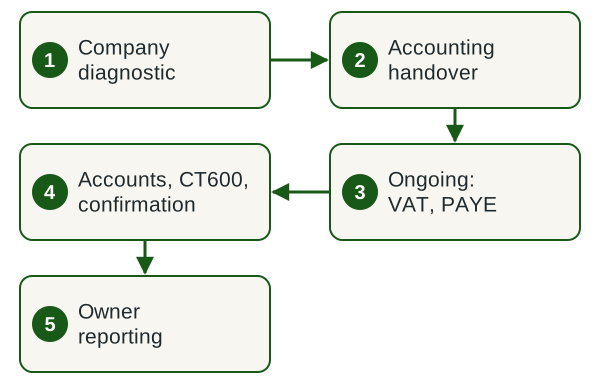
- Diagnostic. We obtain the Companies House record, the latest accounts and CT600, and check dates, VAT, PAYE and verification.
- Handover. We take over the books from the previous accountant against a checklist and record differences.
- Ongoing cycle. Documents, bank reconciliation, payroll and RTI reports, VAT Returns under MTD.
- Annual cycle. Accounts, Corporation Tax and CT600, confirmation statement, audit if required.
- Owner reporting. Management report, CFC and consolidation pack.
Reporting for the owner in Ukraine
For an owner who is tax resident in Ukraine, a UK company is often a controlled foreign company: a stake above 50%, or above 10% when Ukrainian residents together hold 50% or more (subparagraph 39-2.1.2 of the Tax Code of Ukraine). Certified copies of the company's financial statements are attached to the CFC report (subparagraph 39-2.5.2), so the UK accounts are needed in Ukraine too. We prepare the reporting and CFC pack together with our reporting for foreign companies service. An overview of entering the UK market for the group is on innovacg.com.
Registration and visas within the group
Ltd or LLP registration and changes of director or address are arranged by regserv.biz: company registration in the UK. A UK company by itself gives no visa or right to live in the UK. Immigration matters are handled by legal.ua. Key Solutions joins when the company exists or is being registered and is responsible for accounting and reporting.
What we need from you
- company name and Companies House number, or the planned registration date;
- the latest accounts, CT600 and VAT Returns if the company already trades;
- bank and payment account statements and a list of main counterparties;
- turnover, balance sheet total and headcount for the last year, to set the company category;
- a list of directors and PSCs and their verification status;
- contacts of the previous accountant or agent and auditor, if any;
- the shareholders and their tax residence for the CFC pack.
We accept documents electronically and never need bank passwords.
The result
- books kept in software ready for MTD and for software-only accounts filing;
- accounts and confirmation statement filed with Companies House on time;
- CT600 filed and Corporation Tax paid on time;
- VAT Returns and PAYE reports filed without gaps;
- directors and PSCs verified, register data matching the actual structure;
- management report and CFC pack for the owner;
- a deadline calendar for the next year.
Legal basis and sources
Official sources behind this page (GOV.UK and HMRC, checked 10.2026)
- Filing your accounts and Company Tax Return — deadlines for accounts, CT600 and tax payment;
- Confirmation statement guidance — review period and 14 days;
- Micro-entities, small and dormant companies — size categories and audit exemption;
- Penalties for late filing — Companies House penalties;
- Changes to accounts filing from April 2028 — accounts filing reform;
- Rates and allowances: Corporation Tax — rates 2023–2026;
- Pay your Corporation Tax bill — payment deadline and instalments;
- VAT registration, VAT Returns — £90,000 threshold and return deadlines;
- Running payroll: reporting to HMRC — FPS, EPS, PAYE payment;
- Verifying your identity for Companies House — verification from 18.11.2025;
- Set up and run an LLP, HMRC PM147000 — LLP duties and partnership return;
- Tax Code of Ukraine, subparagraphs 39-2.1.2 and 39-2.5.2: controlling person and CFC report.
Why Key Solutions
- Company
- KEY SOLUTIONS AUDIT FIRM LLC, Ukrainian company code 39610085, registered since 30.01.2015.
- Roles
- UK books, accounts, CT600, VAT and PAYE are prepared and filed by a UK partner accountant; any audit is carried out by a registered auditor; the directors approve and sign the accounts; coordination, control and owner reporting are done by Key Solutions.
- Group
- We are part of Innova Consulting Group: company registration by regserv.biz, tax matters by crystal.tax, market entry by innovacg.com.
- Contract
- Scope, liability and confidentiality are set in a contract before work starts.
FAQ
What does a UK company file each year?
A private limited company files annual accounts with Companies House within 9 months of the financial year end (first accounts within 21 months of incorporation), a confirmation statement at least once every 12 months, a CT600 with HMRC within 12 months of the end of the accounting period, plus VAT Returns and PAYE reports if it is VAT-registered and has employees.
When is Corporation Tax due?
9 months and 1 day after the end of the accounting period. Companies with taxable profits above £1.5 million pay in instalments during the year. For the financial years 2023 to 2026 the rates are 25% for profits above £250,000 and 19% up to £50,000, with Marginal Relief in between.
Does a small UK company need an audit?
A small company meeting two of three conditions (turnover up to £15m, balance sheet up to £7.5m, up to 50 employees) can claim audit exemption. A bank, investor or parent company may still ask for audited or reviewed accounts.
What changes in accounts filing from 2028?
Companies House has announced that from April 2028 every company will file accounts through commercial software, small companies and micro-entities will file a profit and loss account, and abridged accounts will be removed.
Who must verify their identity with Companies House?
Since 18 November 2025, directors, LLP members and people with significant control (PSCs). A company cannot file its confirmation statement until all its directors are verified.
What is the penalty for late accounts?
For a private limited company: up to 1 month £150, 1 to 3 months £375, 3 to 6 months £750, more than 6 months £1,500. The penalty doubles if accounts are late two years in a row.
Who files when the owner is in Ukraine?
A UK partner accountant prepares and files the accounts, CT600, VAT and PAYE, and the directors approve and sign the accounts. Key Solutions sets the tasks, checks deadlines and figures and prepares owner reporting, including the CFC pack.
How much does accounting support for a UK company cost?
It depends on transaction volume, VAT registration, employees, company category and the state of past records. We prepare a tailored proposal after a short description of the company.
Related services
Request a tailored proposal for your UK company's accounting
Send the Companies House number, the financial year end, whether the company has VAT registration and employees, last year's turnover and who keeps the books today. We will reply with the scope, the split of roles and how to start.
Request a tailored proposal Telegram WhatsApp