


Accounting and reporting for a Canadian corporation owned from Ukraine means a T2 return to the CRA within 6 months of the tax year end (even when no tax is payable), the tax balance paid 2 months after year end, GST/HST returns once taxable sales exceed $30,000, payroll deductions remitted by the 15th of the following month and T4 slips by the last day of February, plus a yearly registry filing: a federal corporation files its annual return within 60 days after its anniversary date, and an Ontario corporation within 6 months after its tax year end. A corporation controlled by a non-resident is not a CCPC, so it pays federal tax at the 15% general rate plus provincial tax. Key Solutions coordinates this work: a Canadian partner accountant keeps the books and files, and we set the tasks, check deadlines and figures and prepare owner reporting.
Request a tailored proposal Telegram
In short
- For: owners from Ukraine who have or plan a corporation under the federal Act (CBCA) or a provincial statute, and groups where the Canadian company sells services or goods on behalf of a Ukrainian business.
- What we do: take over the books from the previous accountant, set up the CRA and registry calendar, monitor GST/HST, payroll, payments to non-residents and tax instalments, prepare the year-end close, keep the register of individuals with significant control current, and give the owner clear reporting.
- Who files: a Canadian partner accountant prepares and files the T2, GST/HST, payroll reports and NR4; the directors approve the financial statements; the corporation or its representative files the registry annual return.
- Cost: a tailored proposal after a short description of the company, with no public price list.
- To start: send the corporation name and number, whether it is federal or provincial, the tax year end, whether it has GST/HST registration and employees, last year's revenue and who keeps the books today.
What a Canadian corporation files and when
Reporting runs through two channels. The Canada Revenue Agency (CRA) receives tax returns, GST/HST, payroll deductions and withholding on payments to non-residents. The registry, Corporations Canada for federal corporations or the provincial registry, receives the annual return and information on individuals with significant control. The deadlines below come from canada.ca, Corporations Canada and ontario.ca as of 10.2026.
| What to file or pay | When | Where and source |
|---|---|---|
| T2 return | Within 6 months of the tax year end; if the year ends on the last day of a month, by the last day of the 6th month; filed every year, even with no tax payable | CRA; canada.ca |
| Balance of tax (balance-due day) | 2 months after year end; 3 months only for a qualifying CCPC | CRA; canada.ca: balance-due day |
| Tax instalments | Monthly or quarterly, on the last day of the month or quarter under the corporation's schedule | CRA; canada.ca: 2026 deadlines |
| Form T106 | With the T2 deadline, within 6 months, if reportable transactions with non-arm's length non-residents exceed CAN$1,000,000 | CRA; T2 Corporation Guide |
| GST/HST return | Monthly or quarterly filers: 1 month after the period; annual filers: 3 months after year end | CRA; canada.ca: 2026 deadlines |
| Payroll deductions (CPP, EI, income tax) | By the 15th of the following month for a regular remitter; new employers start as regular remitters | CRA; canada.ca: when to remit |
| T4 slips and summary | By the last day of February for the previous year | CRA; canada.ca: 2026 deadlines |
| Part XIII tax on payments to non-residents | By the 15th of the month after the payment | CRA; canada.ca: Part XIII |
| NR4 slips | By the last day of March for the previous calendar year | CRA; NR4 Guide |
| Federal (CBCA) annual return and ISC information | Within 60 days after the anniversary date; not filed for the year of incorporation | Corporations Canada; ised-isde.canada.ca |
| Ontario corporation annual return | Within 6 months after the tax year end through the Ontario Business Registry | Ontario; ontario.ca |
When a due date falls on a Saturday, Sunday or a public holiday recognized by the CRA, the filing is on time if the CRA receives it on the next business day.
A Ukrainian-owned corporation is not a CCPC
Canada's small business benefits go to a Canadian-controlled private corporation (CCPC). One of the conditions is that the corporation is not controlled, directly or indirectly, by one or more non-resident persons (canada.ca: type of corporation). When the main shareholder is a non-resident of Canada, the corporation remains private but has no CCPC status. In practice:
- tax is computed at the general federal rate: 38% basic rate, 28% after the federal abatement, 15% after the general tax reduction; the 9% small business rate is unavailable (canada.ca: corporation tax rates);
- provincial tax at the higher rate is added: 11.5% in Ontario, 12% in British Columbia;
- the balance of tax is due 2 months after year end, as the 3-month rule is for CCPCs only;
- Alberta has no corporate tax collection agreement with the CRA, so a corporation doing business in Alberta files a separate provincial return.
| Province | Federal rate (non-CCPC) | Provincial rate (higher) | Combined |
|---|---|---|---|
| Ontario | 15% | 11.5% | 26.5% |
| British Columbia | 15% | 12% | 27% |
Rates per canada.ca, checked 10.2026. If shareholders change residence, the corporation's status must be checked again, so we record the owners and their residence at the start of each year.
GST/HST
A corporation must register for GST/HST once its taxable sales exceed $30,000 in a single calendar quarter or over four consecutive quarters; until then it is a small supplier and may register voluntarily (canada.ca: when to register). If the threshold is exceeded within one quarter, tax applies from the sale that took it over.
| Province | Rate |
|---|---|
| Alberta, British Columbia, Manitoba, Quebec, Saskatchewan, territories | GST 5% |
| Ontario | HST 13% |
| Nova Scotia | HST 14% from 01.04.2025 |
| New Brunswick, Newfoundland and Labrador, Prince Edward Island | HST 15% |
Rates per canada.ca: GST/HST rates. The place of supply sets the rate, so sales into several provinces are tracked by province. Provincial sales taxes (PST in British Columbia, Manitoba and Saskatchewan, QST in Quebec) are administered by the provinces and checked separately.
Payroll and payments to non-residents
An employer withholds CPP, EI and income tax from pay and remits them to the CRA; a regular remitter does so by the 15th of the following month. T4 slips and the summary are filed by the last day of February. Payroll is kept so that monthly remittances reconcile to the T4s at year end.
When the corporation pays dividends to its Ukrainian owner, Part XIII tax is withheld: the general rate is 25%, and a tax treaty can reduce it (canada.ca: NR4 Guide). A reduced rate requires evidence of the recipient's residence and entitlement, usually Forms NR301–NR303. The tax is remitted by the 15th of the following month, and NR4 slips are filed by March 31. If transactions with a non-arm's length non-resident, such as the owner's Ukrainian company, exceed CAN$1,000,000 in the year, Form T106 is filed with the T2.
Registry, ISC and audit
A federal corporation files its annual return with Corporations Canada within 60 days after its anniversary date; returns filed before the anniversary are not accepted. Since 22 January 2024 information on individuals with significant control (ISC) is filed with the annual return, and changes to the ISC register within 15 days (Corporations Canada: ISC). Corporations Canada may dissolve a corporation that stops filing. Ontario corporations file their annual return through the Ontario Business Registry within 6 months after the tax year end; other provinces have their own rules.
A federal corporation appoints an auditor by default. Shareholders of a non-distributing corporation may resolve not to appoint one. Such a resolution needs the consent of all shareholders, including holders of non-voting shares, and lasts only until the next annual meeting (CBCA, s. 163). We prepare the resolution for each annual meeting; where a bank or investor asks for audited statements, a Canadian auditor carries out the audit.
Records are kept for six years from the end of the last tax year they relate to, at the place of business or residence in Canada; keeping them outside Canada requires written permission from the CRA (canada.ca: keeping records). For a corporation owned from Ukraine this matters, so the location of source documents and the accounting database is agreed before work starts.
Taking over from the previous accountant
For an operating corporation we start with the registry record and the CRA accounts: business number, program accounts RC (income tax), RT (GST/HST), RP (payroll) and NR (non-resident withholding), filed T2s and annual returns. We then reconcile the bank, check CCPC status, filed T4s and NR4s and the ISC register. Differences are recorded in a handover report. Missed years are rebuilt and the missing filings submitted.
What the service includes
- diagnostic: corporate status, CRA accounts, history of T2, GST/HST, payroll and non-resident payments, ISC register;
- selecting and setting up the Canadian partner accountant: scope, document flow, representative access to the CRA;
- bookkeeping with data kept under CRA rules;
- GST/HST returns, payroll remittances and tax instalments monitored before each deadline;
- year-end close, financial statements, T2, T106 where needed, tax payment;
- Part XIII and NR4 for payments to the owner and other non-residents;
- annual return and ISC filing, shareholder resolution on audit;
- management reporting for the owner: profit, cash flow, taxes due;
- a financial statements pack for the Ukrainian owner's CFC report, consolidation with a Ukrainian company on request.
How we work
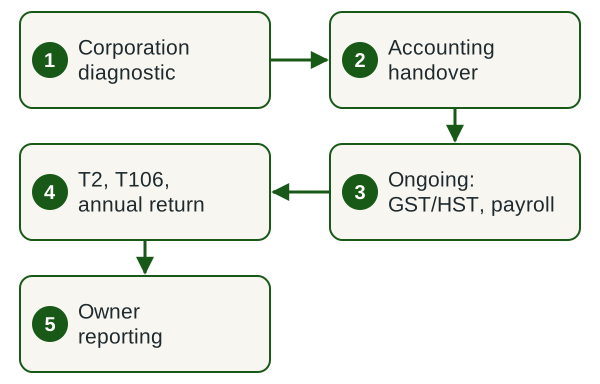
- Diagnostic. We check the registry, CRA accounts, CCPC status and past returns.
- Handover. We take over the books from the previous accountant against a checklist and record differences.
- Ongoing cycle. Documents, bank reconciliation, GST/HST, payroll, payments to non-residents.
- Annual cycle. Financial statements, T2, T106, T4 and NR4, annual return and ISC.
- Owner reporting. Management report, CFC and consolidation pack.
Reporting for the owner in Ukraine
For an owner who is a Ukrainian tax resident, a Canadian corporation is usually a controlled foreign company: a stake above 50%, or above 10% where Ukrainian residents together hold 50% or more (Tax Code of Ukraine, sub-para. 39-2.1.2). Certified copies of the company's financial statements are attached to the CFC report (sub-para. 39-2.5.2), so the corporation's annual statements are prepared for Ukraine as well. We prepare the CFC pack together with reporting for foreign companies. The group's Canadian market entry overview is at innovacg.com.
Registration and immigration: other group companies
Incorporating a federal or provincial corporation and obtaining a business number is handled by regserv.biz: registering a company in Canada. A Canadian corporation gives no right of entry, work or residence by itself. Immigration matters are handled by legal.ua. Key Solutions steps in once the corporation exists or is being formed and is responsible for accounting and reporting.
What we need from you
- certificate and articles of incorporation, corporation number, federal or provincial;
- business number and the list of CRA program accounts;
- the latest T2, financial statements and GST/HST returns, if the corporation is operating;
- bank and payment platform statements;
- shareholder register and ISC register, the owners' tax residence;
- employees and payments to non-residents;
- contacts of the previous accountant and, if any, the auditor.
Documents are exchanged electronically. We do not need bank passwords.
Result
- the corporation's status (CCPC or other private corporation) is confirmed and documented;
- T2 filed, tax and instalments paid on time;
- GST/HST returns, payroll remittances, T4 and NR4 filed without gaps;
- annual return and ISC filed, audit decision taken;
- records kept under CRA rules;
- management report and CFC pack for the owner;
- a CRA and registry deadline calendar for the next year.
Legal basis and sources
Official sources behind this page (canada.ca, Corporations Canada, Justice Laws, ontario.ca, checked 10.2026)
- When to file your T2, Who has to file a T2 — deadline and filing obligation;
- Balance-due day — 2 and 3 months;
- Type of corporation — CCPC conditions;
- Corporation tax rates — federal and provincial rates;
- When to register for GST/HST, GST/HST rates — $30,000 threshold and rates;
- 2026 tax deadlines for businesses — GST/HST, T4, instalments;
- Payroll: when to remit — the 15th;
- NR4 Guide T4061 — Part XIII 25% and NR4;
- T2 Corporation Guide, ch. 2 — Form T106;
- Keeping records — six years, records in Canada;
- Corporations Canada: annual filings, ISC — annual return and ISC;
- Canada Business Corporations Act, s. 163 — resolution not to appoint an auditor;
- Ontario: annual return filing — Ontario annual return;
- Tax Code of Ukraine, sub-paras. 39-2.1.2 and 39-2.5.2: controlling person and CFC report.
Why Key Solutions
- Company
- KEY SOLUTIONS AUDIT FIRM LLC, Ukrainian company code 39610085, registered since 30.01.2015.
- Roles
- Canadian books, T2, GST/HST, payroll reports and NR4 are prepared and filed by a Canadian partner accountant; any audit is carried out by a Canadian auditor; the directors approve the financial statements; coordination, control and owner reporting are done by Key Solutions.
- Group
- We are part of Innova Consulting Group: incorporation by regserv.biz, tax and the owner's CFC matters by crystal.tax, market entry by innovacg.com.
- Contract
- Scope, liability and confidentiality are set in a contract before work starts.
Frequently asked questions
What does a corporation in Canada file?
A T2 return to the CRA within 6 months of the tax year end, even with no tax payable; GST/HST returns once registered; payroll remittances and T4 slips; Part XIII withholding and NR4 slips on payments to non-residents; and a yearly registry filing (federal or provincial annual return).
Can a Ukrainian-owned corporation use the 9% small business rate?
Not if a non-resident of Canada controls it. The 9% rate is for CCPCs only, and a CCPC cannot be controlled by non-residents. Such a corporation pays the 15% federal rate plus provincial tax, for example 11.5% in Ontario.
When is corporate tax paid in Canada?
The balance is due 2 months after year end; 3 months apply only to qualifying CCPCs. During the year the corporation pays instalments monthly or quarterly.
When must a corporation register for GST/HST?
When taxable sales exceed $30,000 in a single calendar quarter or over four consecutive quarters. Until then it is a small supplier and may register voluntarily.
How much is withheld on dividends to a Ukrainian owner?
The general Part XIII rate is 25%, and a tax treaty can reduce it once the recipient's residence is documented. The tax is remitted by the 15th of the following month and NR4 slips are filed by March 31.
Is an audit mandatory for a Canadian corporation?
A federal corporation appoints an auditor by default. If it is not a distributing corporation, all shareholders, including holders of non-voting shares, may resolve not to appoint one; the resolution lasts until the next annual meeting (CBCA, s. 163).
What is the ISC register and when is it filed?
It is the register of individuals with significant control. Since 22.01.2024 federal corporations file ISC information with Corporations Canada together with the annual return and within 15 days of a change.
Can a Canadian corporation's books be kept in Ukraine?
Records are kept for six years at the place of business or residence in Canada; keeping them outside Canada requires written permission from the CRA. The location of documents and the accounting database is agreed before work starts.
Related services
Request a tailored proposal for your Canadian corporation's accounting
Send the corporation number, whether it is federal or provincial, the tax year end, whether it has GST/HST registration and employees, last year's revenue and who keeps the books today. We will reply with the scope, the split of roles and how to start.
Request a tailored proposal Telegram WhatsApp