

Accounting and reporting for a Singapore Pte Ltd owned from Ukraine runs through two authorities: ACRA, the company registrar, and IRAS, the tax authority. Every year the company prepares financial statements, holds an AGM within 6 months of year end (or sends the statements to members within 5 months instead) and files an annual return with ACRA within 7 months of year end, attaching the statements in XBRL unless it is a solvent exempt private company. For IRAS it files Estimated Chargeable Income (ECI) within 3 months of year end, unless revenue is up to S$5 million and ECI is nil, and the income tax return (Form C-S, C-S (Lite) or Form C) by 30 November. The corporate tax rate is 17%. GST at 9% applies once taxable turnover exceeds S$1 million. Key Solutions coordinates this work: a Singapore partner accountant and the company secretary keep the books and file with ACRA and IRAS, and we set the tasks, check deadlines and figures and prepare owner reporting.
Request a tailored proposal Telegram
In short
- For: owners from Ukraine who have or plan a Singapore private limited company (Pte Ltd), and groups where the Singapore company holds IP, raises investment or contracts with Asian clients on behalf of a Ukrainian business.
- What we do: confirm the company's filing profile (exempt private company or not, small company for audit, XBRL type, Form C-S or Form C), set up the ACRA and IRAS calendar, take over the books, keep GST under control, prepare the year-end close, the figures for ECI and the tax return, and give the owner clear reporting.
- Who files: a Singapore partner accountant prepares the accounts, XBRL, ECI and Form C-S or C; the company secretary files the annual return with ACRA; an independent Singapore auditor audits the statements where an audit is required; the directors approve the statements.
- Cost: a tailored proposal after a short description of the company, with no public price list.
- To start: send the company name and UEN, financial year end, shareholders (individuals or a company), revenue range, GST status and who keeps the books today.
First: the company's filing profile
A Singapore company's reporting depends on four answers that are settled before the first close: whether it is an exempt private company, whether it is a small company for audit purposes, which XBRL format applies, and which tax return form it uses.
| Question | Rule | Effect on reporting |
|---|---|---|
| Exempt private company (EPC) | Fewer than 20 members and no corporation holds a beneficial interest in its shares | A solvent EPC only declares solvency in the annual return, with no financial statements filed |
| Small company (audit exemption) | Private company meeting 2 of 3 criteria for the past two financial years: revenue up to S$10 million, total assets up to S$10 million, up to 50 employees; a subsidiary tests the whole group | Statements may be unaudited |
| XBRL format | Simplified XBRL for smaller non-publicly accountable companies (revenue and total assets each up to S$500,000); full XBRL for others that file statements | Simplified XBRL plus a PDF authorised by the directors; full XBRL alone for other filers |
| Tax return form | Form C-S for revenue up to S$5 million with income taxed only at 17%; Form C-S (Lite) up to S$200,000; Form C for all others | Form C is filed with the financial statements and tax computation |
Rules per ACRA (XBRL filing requirements and exemptions, audit exemptions) and IRAS (overview of Form C-S, C-S (Lite) and C), checked 10.2026. A Pte Ltd owned by a Ukrainian or other company is not an EPC, because a corporation holds its shares, so it files financial statements with ACRA.
What a Singapore company files and when
The deadlines below are for a non-listed private company as of 10.2026; FYE means financial year end.
| What to file or do | When | Where and source |
|---|---|---|
| Estimated Chargeable Income (ECI) | Within 3 months after FYE; waived when revenue is up to S$5 million and ECI is nil | IRAS, myTax Portal; iras.gov.sg: ECI filing |
| AGM | Within 6 months after FYE; a private company may skip it by sending the financial statements to all members within 5 months after FYE | acra.gov.sg: AGM due dates |
| Annual return with financial statements (XBRL; plus PDF for simplified XBRL filers) | Within 7 months after FYE; 8 months for a company with share capital and an overseas branch register | ACRA, BizFile; acra.gov.sg: annual return deadlines |
| Form C-S, C-S (Lite) or Form C | By 30 November of the year of assessment, also for a company with no business or a loss, unless IRAS granted a waiver | IRAS; iras.gov.sg: filing guidance |
| GST registration | Taxable turnover above S$1 million in the calendar year: apply 1–30 January of the next year; expected above S$1 million in the next 12 months: within 30 days of the forecast | iras.gov.sg: GST registration |
| GST return (F5) and payment | 1 month after the end of each accounting period, usually quarterly; a nil return is filed too | iras.gov.sg: GST due dates |
| Records | At least 5 years from the relevant year of assessment | IRAS: basic guide for companies |
Example for a company with a 31 December 2025 year end: ECI by 31 March 2026, AGM by 30 June 2026, annual return by 31 July 2026, Form C-S or C for year of assessment 2026 by 30 November 2026. The figures above are rules of law; Key Solutions does not set them.
ACRA: annual return and XBRL
The annual return confirms the company's details, officers and shareholders and, for most companies, carries the financial statements. Since 25 February 2026 ACRA applies updated XBRL filing requirements (ACRA):
- a smaller non-publicly accountable company (revenue and total assets each up to S$500,000 for the current year) files simplified XBRL statements plus a PDF authorised by the directors;
- other companies that must file statements, including insolvent EPCs that are not small, file full XBRL financial statements; no separate PDF is required;
- a solvent EPC does not file statements and only declares solvency; it may file voluntarily;
- the statements filed must be identical to those laid at the AGM or sent to members.
The company must have at least one director ordinarily resident in Singapore and must appoint a company secretary within 6 months of incorporation (ACRA: directors and key officers). The secretary usually files the annual return, so we agree the timeline with the secretary and the accountant at the start of each cycle.
IRAS: ECI, Form C-S and Form C
A Singapore company is taxed at a flat 17% of its chargeable income (IRAS: corporate income tax rates). The partial tax exemption reduces the tax on the first S$200,000: 75% of the first S$10,000 and 50% of the next S$190,000 are exempt, unless the company claims the start-up exemption (IRAS: rates, rebates and exemption schemes).
- ECI is the company's estimate of taxable profit for the year, filed within 3 months after FYE. A company with revenue up to S$5 million and nil ECI is not required to file it.
- Form C-S is the simplified return for companies with revenue up to S$5 million whose income is all taxed at 17% and which do not claim group relief, carry-back or investment allowance; Form C-S (Lite) applies up to S$200,000 of revenue.
- All other companies file Form C together with the financial statements and the tax computation.
- The return is due on 30 November every year, including for a company with no activity or a loss.
GST 9%
GST is charged at 9% (IRAS: current GST rates). Registration becomes compulsory when taxable turnover exceeds S$1 million at the end of a calendar year or is expected to exceed S$1 million in the next 12 months. A registered company files a GST return and pays within 1 month after each accounting period and files a nil return for a period with no transactions. For a company selling services abroad, the partner accountant checks which supplies are zero-rated and how they count toward the threshold.
Audit or unaudited statements
A private company qualifies as a small company and is exempt from audit when it meets at least two of three criteria for the two preceding financial years: revenue up to S$10 million, total assets up to S$10 million, up to 50 employees. A new company tests the current year. A subsidiary qualifies only if the whole group, foreign entities included, also meets the criteria on a consolidated basis (ACRA: audit exemptions). Where an audit is required, it is carried out by an independent Singapore auditor; Key Solutions prepares the audit file.
Taking over from the previous agent
We start with a check: the company profile in BizFile, officers and the secretary, annual returns and statements filed, ECI and tax returns with IRAS notices of assessment, GST status, bank statements and money flows with the owner and related companies. If filings were missed, the partner accountant and secretary prepare them, and the owner receives a risk assessment before anything is filed. Differences are recorded in a handover report.
What the service includes
- diagnostic: EPC status, audit exemption, XBRL type, tax return form, GST status, filing history;
- selecting and setting up the Singapore partner accountant and liaison with the company secretary;
- bookkeeping in cloud software under Singapore financial reporting standards;
- GST returns and GST records where the company is registered;
- year-end close, financial statements and liaison with the auditor where an audit is required;
- XBRL statements and the annual return package for ACRA;
- ECI, Form C-S or Form C with the tax computation;
- management reporting for the owner: profit, cash flow, taxes due;
- a financial statements pack for the Ukrainian owner's CFC report, consolidation with a Ukrainian company on request.
How we work
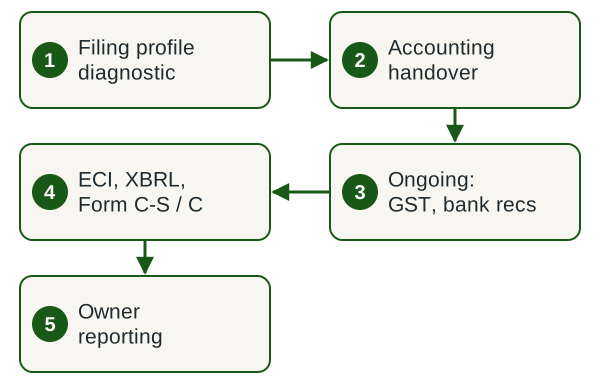
- Diagnostic. We confirm the filing profile and check past ACRA and IRAS filings.
- Handover. We take over the books from the previous agent and record differences.
- Ongoing cycle. Documents, bank reconciliation, GST returns where they apply.
- Annual cycle. ECI, financial statements, AGM or circulation, annual return with XBRL, Form C-S or C.
- Owner reporting. Management report, CFC and consolidation pack.
Reporting for the owner in Ukraine
For an owner who is a Ukrainian tax resident, a Singapore company is usually a controlled foreign company: a stake above 50%, or above 10% where Ukrainian residents together hold 50% or more (Tax Code of Ukraine, sub-para. 39-2.1.2). Certified copies of the company's financial statements are attached to the CFC report (sub-para. 39-2.5.2), and the statements already prepared for ACRA serve this purpose. We prepare the CFC pack together with reporting for foreign companies. The group's Singapore market entry overview is at innovacg.com.
Registration and visas: other group companies
Forming a Pte Ltd and appointing officers is handled by crystal.tax: company registration in Singapore. A Singapore company gives its owner no right to live or work in Singapore by itself; immigration matters are handled by legal.ua. Key Solutions steps in once the company exists or is being formed and is responsible for accounting and reporting.
What we need from you
- the company's BizFile business profile, constitution and register of members;
- details of the directors, the company secretary and the auditor, if any;
- annual returns, financial statements and tax returns filed so far, IRAS notices of assessment;
- GST registration details, if registered;
- bank and payment platform statements;
- a list of transactions with the owner and the owner's other companies: contributions, loans, payments, services;
- employees and payroll, if any;
- the owners' tax residence and the share structure for the CFC pack.
Documents are exchanged electronically. We do not need bank passwords.
Result
- the company's filing profile is confirmed and documented;
- ECI filed within 3 months or the waiver conditions documented;
- AGM held or statements circulated, annual return with XBRL filed within 7 months;
- Form C-S or Form C filed by 30 November;
- GST returns filed every period where the company is registered;
- management report and CFC pack for the owner;
- an ACRA, IRAS and GST deadline calendar for the next year.
Legal basis and sources
Official sources behind this page (ACRA and IRAS, checked 10.2026)
- ACRA: annual return deadlines — 7 months after FYE for non-listed companies;
- ACRA: AGM due dates — 6 months, exemption by circulation within 5 months;
- ACRA: XBRL requirements and exemptions — full and simplified XBRL, EPC;
- ACRA: audit exemptions — small company criteria;
- IRAS: ECI filing — 3 months, waiver;
- IRAS: Form C-S, C-S (Lite), C, IRAS: filing guidance — conditions and 30 November;
- IRAS: corporate income tax rates — 17%;
- IRAS: GST registration, IRAS: GST due dates — S$1 million, 1 month;
- Tax Code of Ukraine, sub-paras. 39-2.1.2 and 39-2.5.2: controlling person and CFC report.
Why Key Solutions
- Company
- KEY SOLUTIONS AUDIT FIRM LLC, Ukrainian company code 39610085, registered since 30.01.2015.
- Roles
- Singapore books, XBRL, ECI, tax and GST returns are prepared and filed by a Singapore partner accountant; the annual return is filed by the company secretary; an audit, where required, is carried out by an independent Singapore auditor; the directors approve the statements; coordination, control and owner reporting are done by Key Solutions.
- Group
- We are part of Innova Consulting Group: company formation by crystal.tax, market entry by innovacg.com.
- Contract
- Scope, liability and confidentiality are set in a contract before work starts.
Frequently asked questions
What does a Singapore Pte Ltd file every year?
With ACRA: an annual return within 7 months after the financial year end, with financial statements in XBRL unless it is a solvent exempt private company. With IRAS: Estimated Chargeable Income within 3 months after year end (unless waived) and Form C-S, C-S (Lite) or Form C by 30 November. A GST-registered company also files GST returns every period.
When is the annual return due with ACRA?
Within 7 months after the financial year end for a non-listed company, or 8 months if it has share capital and keeps a branch register outside Singapore. For a 31 December 2025 year end the deadline is 31 July 2026.
Does a Singapore company have to hold an AGM?
A non-listed company holds its AGM within 6 months after year end. A private company can skip the AGM if it sends its financial statements to all members within 5 months after year end.
Which companies file financial statements in XBRL?
Companies that must file statements file them in XBRL: simplified XBRL plus a PDF authorised by the directors if revenue and total assets are each up to S$500,000 and the company is not publicly accountable, full XBRL otherwise. A solvent exempt private company files no statements; a Pte Ltd owned by another company is not an exempt private company.
Does a company with no revenue have to file ECI?
ECI is not required when annual revenue is up to S$5 million and ECI is nil. A company with revenue above S$5 million files ECI within 3 months after year end even when ECI is nil.
What is the difference between Form C-S and Form C?
Form C-S is a simplified return for Singapore companies with revenue up to S$5 million whose income is all taxed at 17% and which claim no group relief, carry-back or investment allowance; Form C-S (Lite) applies up to S$200,000. Every other company files Form C with its financial statements and tax computation. All are due by 30 November.
Is a small Singapore company exempt from audit?
A private company is exempt when it meets at least two of three criteria for the two preceding financial years: revenue up to S$10 million, total assets up to S$10 million, up to 50 employees. A subsidiary also needs its whole group, foreign entities included, to meet the criteria on a consolidated basis.
Who keeps the books and files for a Singapore company?
A Singapore partner accountant prepares the accounts, XBRL, ECI, tax and GST returns; the company secretary files the annual return; an independent Singapore auditor audits where required; the directors approve the statements. Key Solutions coordinates the work, checks deadlines and figures and prepares owner and CFC reporting.
Related services
Request a tailored proposal for your Singapore company's accounting
Send the UEN and financial year end, the shareholders, revenue range, GST status, whether the company is audited and who keeps the books and the secretarial work today. We will reply with the scope, the split of roles and how to start.
Request a tailored proposal Telegram WhatsApp